

 CN

Factory direct sales of door panel, drawer, wardrobe door rebound device, push-type exposed and concealed door rebound device
Push-to-Open Cabinet Latches: The Small Hardware Upgrade That Makes Cabinets Feel Premium
Handles and knobs define the look of a cabinet, but the feeling of a cabinet comes from something you never see: the catch behind the door. A push-to-open latch — also called a rebound device, touch latch, or press-and-release catch — turns a plain door panel into a touch-activated surface. Press once, and the door springs open. Press again, and it locks shut. No pull, no protrusion, no visual clutter.
This blog looks at the white slimline push-to-open latch manufactured in Guangdong, China — a plastic-bodied rebound device designed for cabinet doors, wardrobe doors, and drawers — and explains where it fits, how it installs, and why it has become a steady seller for cross-border e-commerce sellers on platforms such as eBay.
What Is a Push-to-Open Rebound Latch?
A push-to-open latch is a mechanical catch that holds a door or drawer closed under spring tension. When the panel is pressed inward, the internal mechanism releases and pushes the panel back out a few millimeters, giving you enough of a gap to grip and open it. Press the panel closed again, and the catch re-engages with an audible click.
The result is a handle-free installation. For modern kitchens, minimal wardrobes, and sleek bathroom vanities, that means a flat, uninterrupted door front — a look that normally requires far more expensive hardware solutions.
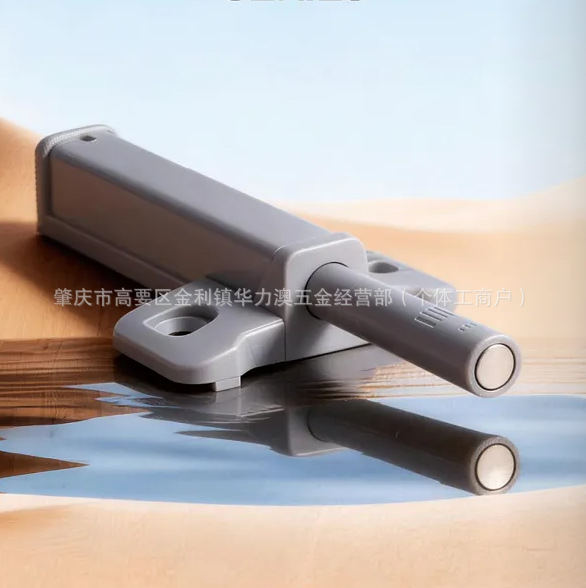
Product Specifications at a Glance
| Attribute | Detail |
|---|---|
| Product type | Push-to-open latch / rebound device / touch catch |
| Application | Cabinet doors, drawer fronts, wardrobe doors |
| Mounting options | Surface mount (exposed) and concealed / hidden mount |
| Material | Plastic body |
| Color and form | White, slimline elongated profile |
| Place of origin | Guangdong, China |
| Supply model | Factory direct |
| Source type | Cross-border export dedicated supply |
| Primary downstream channel | eBay |
| Main sales region | China |
| Authorized private label available | No |
Why the Slimline White Profile Works So Well
The elongated, narrow body of this latch is not a cosmetic choice — it is a practical one. A slim housing fits into shallow clearances behind thin cabinet panels, inside wardrobe side walls, and along drawer boxes where a bulkier catch would foul the frame. The white finish blends into light-colored melamine, MDF, and painted board, so even when the unit is surface-mounted and therefore visible when the door is open, it stays visually quiet.
Because the body is plastic, the latch is light, corrosion-resistant in humid rooms such as bathrooms and utility areas, and gentle on door faces — no metal edges pressing against a finished panel. That combination makes it a sensible default for volume cabinet production as well as for one-off renovation projects.
Surface Mount vs. Concealed Mount
One of the strongest selling points of this part is that it serves both mounting styles, which means a single SKU can cover a wide range of cabinet designs.
Surface mount (exposed)
- Fitted directly to the cabinet carcass or the inside face of the door.
- Fastest to install — ideal for retrofits, rentals, and aftermarket upgrades.
- Easy to reach and adjust without removing panels.
- Best suited to standard 16–18 mm board construction.
Concealed mount (hidden)
- Recessed behind the door or inside the cabinet for a completely invisible fit.
- Keeps the interior looking clean, which matters for open-shelf wardrobes and glass-front cabinets.
- Preferred by furniture manufacturers building handle-free kitchens and closets.
- Requires a shallow bore or cutout, so measure clearance before drilling.
Where This Latch Performs Best
The rebound mechanism is a low-force, short-throw design, so it shines in these applications:
- Handle-free kitchen cabinets — base and wall units with slab or handleless doors.
- Wardrobes and closet doors — including slim sliding-adjacent panels that need a firm push-release action.
- Drawer fronts — particularly shallow drawers on dressers, bedside tables, and bathroom vanities.
- TV units and storage benches — where a clean front elevation is the design goal.
- Bathroom and laundry cabinetry — plastic construction resists damp conditions better than untreated metal components.
- Retrofit projects — converting existing handle doors to push-open without replacing the door panels.
Installation Notes for Fitters and Sellers
Push-to-open catches are simple parts, but a few details decide whether the door feels crisp or spongy:
- Check the gap first. Confirm the door-to-carcass clearance before choosing surface or concealed mounting. Too tight a gap and the panel will rub; too wide and the catch will not engage.
- Align catch and striker. The release pin must meet the opposing plate squarely, not at an angle, or the door will pop open unevenly.
- Use the adjustment range. Most rebound latches allow a small amount of travel tuning; use it to fine-tune how far the door springs out.
- Match the spring force to the panel. A light door needs a light catch. Oversized panels may need two units — one near the top and one near the bottom — for an even release.
- Test ten cycles. Open and close the door repeatedly after fitting to confirm consistent engagement before finishing the installation.
Why Buy Factory Direct from Guangdong
Guangdong remains one of the world's densest hardware manufacturing clusters, and this latch is a good example of why that matters. Buying factory direct removes the distributor layer, which means:
- Consistent unit cost across repeat orders, which protects margins on marketplace listings.
- Direct communication on specifications, packing, and packaging artwork.
- Volume flexibility — small trial batches and larger restock orders from the same source.
- Export-ready supply — this item is designated as a cross-border export dedicated source, meaning it is produced and packed with overseas fulfillment in mind.
For eBay sellers in particular, that last point matters. Marketplace buyers judge hardware on three things: does it arrive intact, does it fit as described, and does it work on the first try. A factory-direct supply line with stable specifications supports all three — and a slim white plastic latch is a low-risk item to stock because it does not corrode, does not shatter in transit, and does not require a model-specific fitment.
Packing and Listing Tips for Marketplace Sellers
If you plan to list this product, a few practical pointers can lift conversion:
- State clearly in the title that it is a push-to-open catch, not a magnetic catch — buyers search with specific intent.
- Photograph the latch next to a ruler or coin so the slimline scale is obvious.
- Include a simple line drawing showing both surface and concealed mounting positions.
- Note the plastic body and white finish as features, not caveats: no rust, no scratching, blends with light cabinetry.
- Bundle in practical quantities — pairs and multi-packs convert better than single units for renovation buyers.
Frequently Asked Questions
Does this latch work without a handle?
Yes. That is its primary purpose. Press the door inward to release, press again to close. No handle or knob is required.
Can one latch hold a full-size wardrobe door?
A single unit suits standard cabinet doors and light wardrobe panels. Large or heavy doors are more reliable with two units positioned at the top and bottom of the opening edge.
Is it suitable for bathroom cabinets?
Yes. The plastic construction will not rust in humid conditions, which makes it a better long-term choice than untreated metal catches in bathrooms and laundry rooms.
Can it be installed on existing cabinets?
Surface mounting is a straightforward retrofit on most standard cabinet construction. Concealed mounting requires a shallow recess, so it is better planned at the build stage.
Is private labeling available?
No. There is currently no authorized private label program for this item. It is supplied as a standard factory product.
Which markets is it intended for?
It is produced as a cross-border export dedicated source with eBay as the primary downstream platform. The main sales region on record is China.
Final Thoughts
Push-to-open latches are the kind of component that disappears into a project — until someone presses a handle-free cabinet door and it opens smoothly, and suddenly the whole kitchen feels better engineered. For cabinet makers, the appeal is a single white slimline part that covers surface and concealed mounting. For eBay sellers, the appeal is a factory-direct, export-ready item with predictable quality and no private-label commitments.
If you are sourcing handle-free cabinet hardware, this rebound latch is a low-cost, high-perceived-value addition to the range — small enough to stock in volume, versatile enough to sell into kitchens, wardrobes, drawers, and retrofit projects alike.