

 CN

Push-to-Open Cabinet Catches: The Small Hardware Upgrade That Transforms Handle-Free Doors and Drawers
Minimalist kitchen fronts, frameless wardrobe doors, and sleek drawer stacks all share one design challenge: without a handle, how do you open them? The answer is a push-to-open latch — a compact spring-loaded mechanism that lets you open a door or drawer simply by pressing it. This article takes a close look at a factory-direct, white slim-profile push-to-open catch built for exactly that job, and explains why it has become a steady seller for eBay sellers and export buyers around the world.
What Is a Push-to-Open Catch?
A push-to-open catch (also called a push latch, rebound catch, or touch-release catch) is a small mechanical device mounted behind a cabinet door or inside a drawer frame. When you press the door inward, the latch locks the panel closed. Press it again and the spring releases, pushing the door out a few millimetres so you can pull it open with your fingers. No handle, no knob, no visible hardware on the face of the door — just a clean, uninterrupted surface.
The model featured here is a white, slim-profile plastic catch. Its narrow body makes it easy to fit into tight cabinet corners, narrow stiles, and shallow drawer boxes where bulkier catches simply will not go.
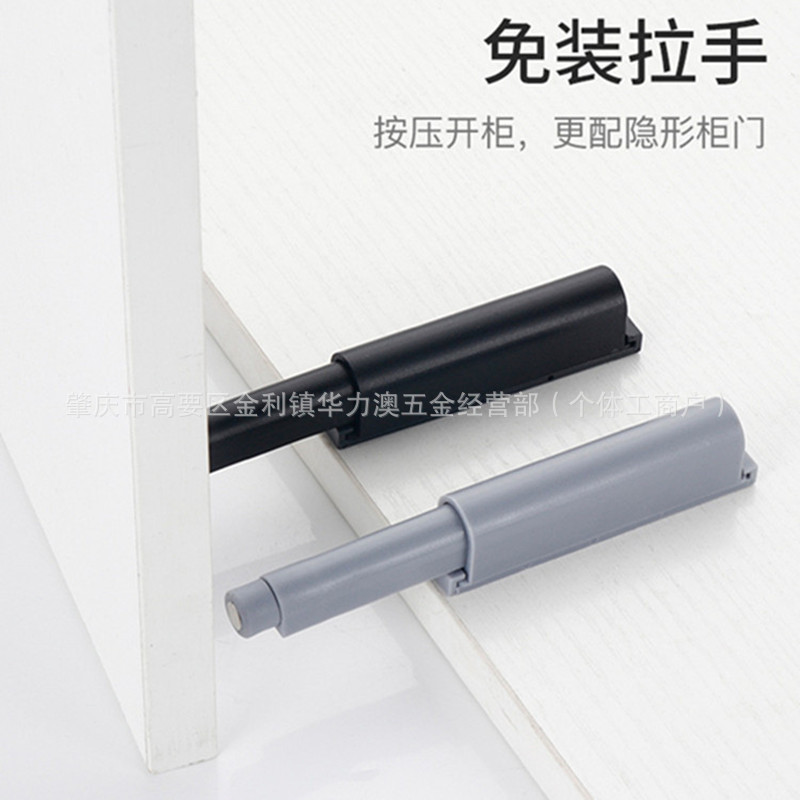
Key Features at a Glance
- Push-to-open mechanism: Press once to close and lock, press again to release and pop the door open.
- White slim-line design: A neutral white finish and narrow body suit modern white, cream, and light wood cabinetry.
- Plastic construction: Lightweight, rust-free, and suitable for humid rooms such as kitchens and bathrooms.
- Surface and concealed mounting: The catch works as a visible 明装 mount against the cabinet frame, or as a concealed 暗装 fitting that stays hidden behind the door panel.
- Factory-direct supply: Manufactured in Guangdong, China, and supplied directly from the production line to trade buyers.
- Export-ready: Designed as a cross-border e-commerce source item, with packing and quantities suited to overseas fulfilment.
Why Handle-Free Cabinets Are Booming
Handle-free design has moved from high-end interiors into mainstream retail. Flat-front kitchens, integrated appliances, wall-to-wall wardrobes, and floating bathroom vanities all rely on a clean, unbroken surface. Removing handles does more than improve appearance — it also makes cabinetry easier to clean, removes the risk of clothes snagging on drawer pulls, and creates a safer surface in tight walkways.
Every handle-free door and drawer needs a release mechanism. That is precisely where the push-to-open catch earns its place. It is a low-cost component with a high perceived value: the customer experiences a smooth, modern touch-release motion every single time they use the cabinet.
Where This Catch Works Best
- Kitchen wall and base units: Press-release access on flat-front doors and handle-free drawers.
- Wardrobes and closets: Ideal for sliding or hinged doors that would otherwise need visible pulls.
- Bathroom vanities: Plastic construction will not corrode in damp environments.
- TV units and living room storage: Keeps media consoles clean and cable-free on the surface.
- Office and shop fittings: A simple way to update display cabinets and storage walls without drilling for handles.
- DIY refurbishment: Perfect for homeowners filling old handle holes and switching to a push-open look.
How to Install a Push-to-Open Catch
Installation is straightforward and needs only basic hand tools. Follow these general steps:
- Check the clearance. Confirm there is enough room behind the door or drawer front for the catch body and its spring travel.
- Choose your mounting position. Fit the catch near the opening edge of the door, opposite the hinge side, or at the top corner of a drawer box where the front panel meets the frame.
- Mark and drill. Use the catch body as a template to mark the screw holes, then pre-drill pilot holes.
- Fix the catch. Screw the catch to the cabinet frame (surface mount) or recess it into the panel for a concealed fit.
- Test the travel. Press the door closed. It should latch firmly. Press again and the door should release and spring outward.
- Adjust if needed. Small position changes on the catch or the striker plate will usually correct any alignment or tension issues.
Tip for installers: pair each push-to-open catch with a soft-close hinge when working on hinged doors. The hinge controls the closing speed, and the catch handles the locking and release action — the two together give a smooth, premium feel.
Built for Trade Buyers and Online Sellers
This catch is positioned as a factory-direct item rather than a retail-packaged accessory. That means buyers get production-line pricing, consistent quality across repeat orders, and quantities that suit both small test batches and full container loads.
Key commercial points for resellers:
- Made in Guangdong, China — one of the world's most established hardware manufacturing regions.
- Supplied as a cross-border e-commerce source product, ready for overseas shipping and marketplace fulfilment.
- Well suited to eBay listings, where compact, low-cost hardware items perform strongly as add-on purchases and multi-packs.
- Neutral white colour and slim form factor reduce the number of SKUs a seller needs to stock — one model covers most light-coloured cabinet ranges.
- No own-brand authorisation required, so sellers can list the item under their own store name and build their own product photography and descriptions.
Buyer Checklist Before You Order
- Confirm the panel thickness of the doors and drawers you plan to fit.
- Measure the gap between the door front and the cabinet frame to make sure the catch fits.
- Decide on mounting style — visible surface fit or concealed recessed fit.
- Count the openings you need to cover. One catch per door or drawer front is standard for most cabinet sizes.
- Ask for samples before placing a bulk order so you can test the spring tension and fit quality.
Frequently Asked Questions
Does one catch work for a whole cabinet door?
For most standard cabinet and wardrobe doors, one catch per door is enough. Very wide or heavy doors may need two catches fitted symmetrically.
Will it work in a bathroom or kitchen?
Yes. The plastic body will not rust, which makes it suitable for humid rooms where metal catches can corrode over time.
Can it be fitted to an existing cabinet that already has handles?
Yes. Many customers remove the handles, fill the old screw holes, and fit a push-to-open catch to achieve a handle-free finish.
Is it suitable for drawers as well as doors?
Yes. The same catch works on drawer fronts and wardrobe doors, as long as there is sufficient clearance behind the panel.
Final Thoughts
Handle-free cabinetry depends on reliable, low-cost hardware, and the push-to-open catch is the component that makes the design work. This white slim-profile model delivers the essentials: a press-release mechanism, a rust-free plastic body, visible or concealed mounting options, and factory-direct supply from Guangdong for export and e-commerce buyers. For sellers on eBay and other marketplaces, it is a compact, easy-to-ship, repeat-purchase item that fits neatly into the growing handle-free furniture trend.
Whether you are fitting out a single kitchen or sourcing stock for a full marketplace listing, this push-to-open catch offers a simple, dependable way to bring touch-release convenience to every cabinet door and drawer in the room.