

 CN

Push-to-Open Cabinet Latches: A Simple, Reliable Upgrade for Doors and Drawers
Cabinet hardware is one of those details that quietly determines how a kitchen, wardrobe, or bathroom feels to use every single day. A door that opens with a smooth press and closes with a firm, satisfying click feels premium. A door that needs two hands, a fumbled grip, or a rattling knob feels cheap — even when the cabinet itself is well built. That is exactly the gap a push-to-open latch is designed to close.
This guide covers the press-to-open rebound latch for cabinet doors and drawers: what it does, how surface-mount and concealed-mount versions differ, where it works best, and why buyers sourcing on eBay and other marketplaces keep coming back to factory-direct supply from Guangdong.
What Is a Push-to-Open Latch?
A push-to-open latch — sometimes called a rebound catch, press catch, or touch latch — is a small mechanical device mounted behind or inside a cabinet door or drawer front. Instead of pulling a handle, you press the door inward. The latch releases, and a spring pushes the door back out far enough to grab. Press it again and the catch re-engages, holding the door closed.
The result is a clean, handle-free front. That look dominates modern kitchen design, minimalist wardrobes, and sleek bathroom vanities, and it also solves practical problems in tight spaces where a protruding knob would catch on something.
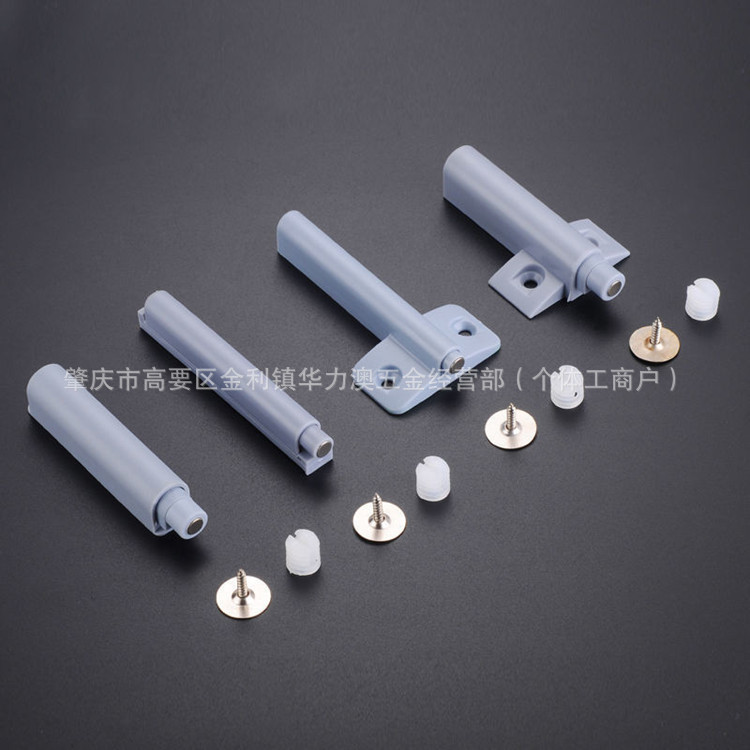
Product Overview
This particular model is the white, slim-profile version — a long, narrow body that fits easily into shallow recesses and narrow cabinet frames where bulkier catches simply will not go. Key specifications:
- Material: Durable plastic housing with an internal spring mechanism
- Colour: White, with a slim, elongated body profile
- Mounting: Suitable for both surface-mount (exposed) and concealed installation
- Operation: Press-to-open, press-to-close rebound action
- Origin: Guangdong, China
- Supply type: Factory-direct, cross-border export dedicated source
- Primary downstream channel: eBay and comparable online marketplaces
- Brand: No licensed private label available — neutral, unbranded supply
The white finish is a practical choice. It blends into light-coloured cabinet interiors, white melamine, and painted MDF, so the mechanism stays visually unobtrusive even in exposed installations where it can be seen when the door is open.
Why the Slim Profile Matters
Not every cabinet has generous clearance. Framed cabinet doors, slim drawer boxes, and thin wardrobe panels leave very little room for hardware. Bulky catches hit the frame, rub against the drawer box, or force the door to sit proud of the carcass — all of which ruin the flush finish that push-to-open hardware is supposed to deliver.
A slim, elongated body handles these constraints in three ways:
- It fits narrow frames. The long, low housing sits comfortably in the gap behind a thin-framed door where a round or square catch would not.
- It mounts flat. The extended base distributes load and sits flush against the cabinet surface, reducing wobble over time.
- It works in both mounting styles. The same unit can be installed on the surface of the carcass or concealed behind the door, depending on clearance and preference.
Surface-Mount vs. Concealed Installation
Buyers often ask which installation method is better. The honest answer is that it depends on the cabinet, not the latch.
Surface-Mount (Exposed)
Here the latch is screwed directly onto the cabinet carcass or the back of the door, with the body visible when the door is open. It is the faster option, requires no routing or drilling of deep recesses, and is ideal for retrofits and furniture assembly lines where speed matters. Because this model is white and slim, an exposed installation stays discreet.
Concealed (Recessed)
Concealed mounting seats the latch into a recessed pocket, so nothing shows when the door is open. It delivers the cleanest look and is preferred for premium kitchens and high-end wardrobe fit-outs. It takes more preparation time, and the recess must match the body dimensions exactly — which is another argument for a slim, consistent profile.
Both methods use the same unit, so a distributor or retailer can stock a single SKU and serve customers with either requirement.
Where These Latches Perform Best
- Kitchen base and wall units — handle-free doors and lift-up flaps
- Wardrobes and closets — flush door fronts in bedrooms and dressing rooms
- Bathroom vanities — clean lines with no protruding hardware to catch on towels
- TV units and living room storage — minimal fronts with no visible knobs
- Office and shop fit-outs — quick push access on stock and filing cabinets
- Campervans, caravans, and boat cabins — flush fronts are safer in confined, moving spaces
- Furniture assembly and flat-pack production — low-cost, low-tooling closure for high-volume runs
Why Buyers Source This Model Factory-Direct
For eBay sellers and small-to-mid-volume distributors, sourcing hardware is a balancing act: unit cost has to be low, but arrival quality and consistency decide whether the listing survives its first fifty reviews. This product addresses both sides.
Direct factory supply
The latch comes straight from the production source in Guangdong, with no distributor layer between the factory floor and the buyer. That keeps pricing competitive and makes custom order quantities and repeat orders easier to negotiate.
Export-ready supply channel
It is a cross-border export dedicated source, meaning it is produced and packed with overseas fulfilment in mind — suitable for marketplace sellers, third-party logistics, and consolidated shipments.
Neutral, unbranded stock
There is no licensed private label attached, so the product carries no conflicting branding. Sellers can list it under their own store identity, and buyers who need unbranded hardware for OEM furniture production get a clean, logo-free component.
Proven marketplace fit
The main downstream channel for this item is eBay, where push-to-open catches are steady, repeat-purchase products. Buyers tend to order in multiples — replacing a set, restocking a hardware drawer, or completing a full kitchen project — which makes them attractive for bundled listings and multi-packs.
Installation in Six Steps
- Check the gap. Confirm there is enough clearance between the door and the carcass for the latch body and its travel.
- Mark the position. Place the latch near the opening edge of the door, opposite the hinges, so the press force is even.
- Drill pilot holes. Use a bit slightly narrower than the screws to avoid splitting MDF or chipboard.
- Fix the body. Screw the latch into place — onto the carcass for surface-mount, or into the recessed pocket for concealed mounting.
- Test the press action. Press the door closed until it clicks, then press again to confirm it releases and springs open.
- Fine-tune. If the door does not release cleanly, adjust the latch position slightly or add a small bumper pad to tune the closing depth.
Install one latch per door for standard cabinet doors. For wide or heavy doors, and for drawer fronts above roughly 60 cm, use two latches spaced evenly to keep the press action balanced.
Buying Advice for Retailers and Project Buyers
- Order a sample first. Test the spring tension against your actual door weight — press catches are sensitive to load.
- Standardise on one SKU. A white slim latch covers both surface and concealed installations, which simplifies stock and reduces dead inventory.
- Bundle with screws and bumpers. Multi-pack listings that include mounting screws and rubber pads convert better and reduce buyer questions.
- Check packaging for export. Confirm bagging, carton counts, and labelling match your marketplace or warehouse requirements.
- Plan for replacement demand. These are consumable, low-cost parts — buyers reorder. Reliable supply matters more than a marginal unit-price difference.
Frequently Asked Questions
Does one latch work for both doors and drawers?
Yes. The mechanism is identical; only the mounting position changes. On drawers, fit the latch behind the drawer front or on the back of the box, positioned so the front presses squarely against it.
Will it work with soft-close hinges?
Push-to-open latches are designed for standard hinges. Soft-close mechanisms dampen the closing motion, which can interfere with the release action, so check compatibility before specifying them together.
What door weight can it handle?
Light to medium doors are the intended application. For large or heavy fronts, fit two latches so the press force is shared and the release stays consistent across the door width.
Is drilling required?
Surface mounting needs only pilot holes for the screws. Concealed installation requires a recess cut to match the latch body, so it is better suited to workshop or pre-assembly environments.
Is the product branded?
No. There is no licensed private label attached to this item, so it ships as neutral, unbranded hardware.
Final Thoughts
A push-to-open latch is one of the cheapest ways to make a cabinet feel significantly better made. It removes hardware clutter from the door front, solves the problem of handles catching in tight spaces, and gives any kitchen, wardrobe, or vanity the clean, flush look that buyers actively search for.
With its slim white body, dual surface and concealed mounting options, and factory-direct supply from Guangdong through an export-ready channel, this model is a practical, low-risk addition to any hardware range — whether you are listing on eBay, stocking a trade counter, or fitting out a project.