

 CN

RT-002 Nylon Brush Roller: A Reliable Cleaning and Conveying Solution for Food Machinery
In the production of tofu skin, thousand-sheet (qianzhang) products and other soy-based foods, the brush roller is a small component that quietly determines a great deal about output quality. It guides the sheet, removes surface residue, and keeps the conveyor path clean without damaging delicate protein films. The RT-002 nylon brush roller from Zhonghuiya (中徽亚), manufactured in Tongcheng, Anhui Province, is designed specifically for this demanding environment — food machinery that runs hot, runs wet, and runs continuously.
This article explains what the RT-002 offers, where it fits in a production line, how customization works, and what buyers should consider before ordering.
Why the Brush Roller Matters in Tofu Skin and Thousand-Sheet Production
Tofu skin is formed by lifting a thin protein film from heated soymilk. The film is fragile, moist, and slightly adhesive. Thousand-sheet products go through a similar sequence of sheet forming, folding, pressing, and conveying. In both processes, the brush roller performs several jobs at once:
- Sheet guidance: gently pressing and guiding the film so it stays centered on the roller path.
- Surface cleaning: lifting residual pulp, crumbs, and small fragments from rollers and belts.
- Tension control: maintaining even contact pressure so the sheet does not wrinkle or tear.
- Debris removal: keeping the line free of build-up that could cause jams or hygiene issues.
A brush with the wrong filament, density, or hardness can scratch the sheet, shed fibers, or deform under heat. The RT-002 is built around the opposite priorities: stable nylon filament, controlled density, and a structure that holds its shape in warm, humid conditions.
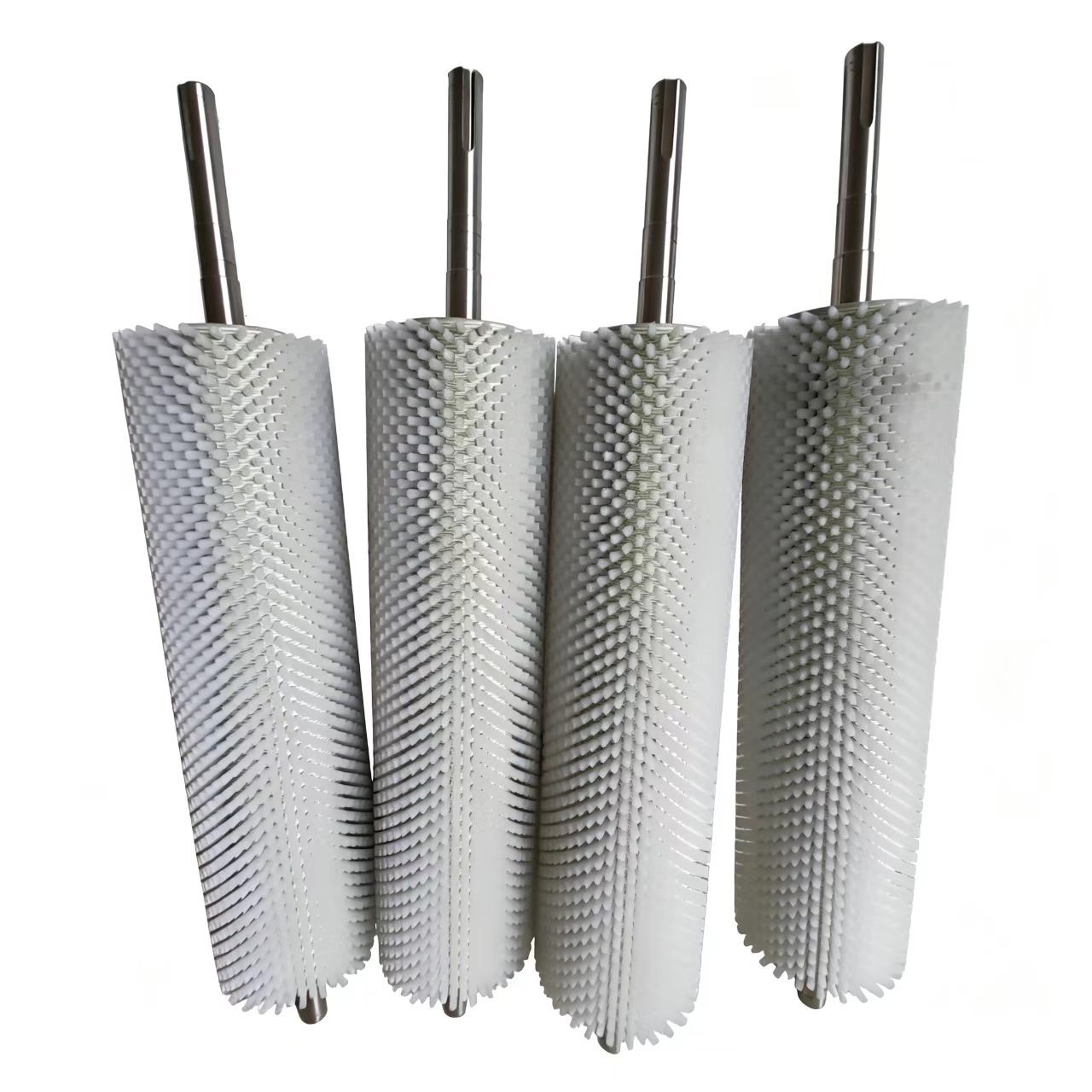
Product Overview: RT-002 Food Machinery Brush Roller
The RT-002 is a tool-grade brush roller classified as a tool brush. It is produced by Zhonghuiya, a manufacturer based in Tongcheng, Anhui — a region long associated with industrial brush production in China. The product is domestically manufactured, not imported, which keeps lead times short and allows flexible customization for buyers who need non-standard dimensions.
| Attribute | Specification |
|---|---|
| Brand | Zhonghuiya |
| Model | RT-002 |
| Product type | Food machinery brush roller / tool brush |
| Filament material | Nylon |
| Bristle length | Customized to order |
| Dimensions and material | Customized to order |
| Heat resistance | High-temperature resistant construction |
| Place of origin | Tongcheng, Anhui, China |
| Imported? | No |
| Pricing | Quoted according to specification and material |
Key Features of the RT-002 Nylon Brush Roller
1. Nylon Filament for Food-Contact Environments
Nylon is one of the most widely used filaments for food machinery brushes because it combines flexibility, abrasion resistance, and good dimensional stability. Unlike stiff wire bristles, nylon will not scratch stainless steel rollers or tear a fragile tofu skin sheet. It also resists moisture absorption far better than many natural fibers, which matters in a wash-down environment where the line is cleaned between batches.
2. High-Temperature Resistance
Thousand-sheet and tofu skin lines operate with heated rollers, steam, and warm air. Brush rollers positioned near the sheet-forming stage are exposed to elevated temperatures for hours at a time. The RT-002 is built with a heat-resistant construction so the filament does not soften, curl, or permanently deform during normal production runs.
3. Customizable Bristle Length
Bristle length directly controls contact pressure. A longer bristle is softer and more forgiving; a shorter bristle is firmer and more effective for scraping residue. Because thickness, moisture content, and line speed vary from one factory to another, the RT-002 bristle length is made to order rather than fixed. Buyers simply provide the target application and the manufacturer matches the filament length accordingly.
4. Customizable Shaft and Roller Dimensions
Brush rollers are usually retrofitted into existing equipment or supplied as a replacement part. That means the shaft diameter, overall length, end fittings, mounting pattern, and core material all need to match the machine. Zhonghuiya produces the RT-002 to drawing or to sample, so an OEM replacement, a spare part, or a new-build component can all be accommodated.
5. Balanced Filament Density
Density affects both cleaning efficiency and air flow. Too dense, and the roller traps pulp and moisture; too sparse, and it leaves gaps in the cleaning path. The RT-002 is tufted to a density appropriate to the food machinery application, giving consistent contact across the full working width.
Where the RT-002 Is Used
Tofu Skin Machines (Doupi Machines)
In tofu skin production, the brush roller is typically positioned to press the film evenly as it leaves the forming surface, and to clear residual film fragments from the transfer rollers. The soft nylon contact preserves the integrity of the sheet while keeping the line clean.
Thousand-Sheet Machines (Qianzhang Machines)
Thousand-sheet production involves repeated folding and pressing. Brush rollers help align the sheet before folding, remove loose particles between layers, and maintain consistent tension so the final stack has an even texture.
Other Food Processing Equipment
The same construction suits vegetable washing lines, noodle and wrapper machines, baked goods conveyors, and general food-contact conveying systems where a heat-resistant, non-scratching brush roller is required.
How to Specify Your RT-002 Brush Roller
Because the RT-002 is a customized product, the ordering conversation is straightforward but specific. Providing the following details will shorten the quotation and production cycle considerably:
- Roller dimensions: overall length, outer diameter, shaft diameter.
- Shaft material and ends: stainless steel, galvanized steel, or other, plus the mounting style.
- Bristle length and diameter: usually expressed in millimeters.
- Filament type: standard nylon or a specific grade, if the application demands it.
- Filament density: tuft spacing or a photograph of the existing brush.
- Operating temperature: the maximum temperature the roller will see in service.
- Quantity: single replacement part, spare-parts stock, or recurring order.
A technical drawing or a worn sample is often the fastest way to communicate requirements. Photos of the mounting area on the machine are also useful, particularly when the original part has no documentation.
Maintenance and Replacement Guidance
A brush roller is a wear part, but a well-specified one lasts far longer than an improvised replacement. A few practices extend service life:
- Check filament tips regularly for bending, matting, or embedding of residue.
- Clean the brush with warm water and a food-safe cleaning agent during scheduled wash-downs.
- Allow the roller to dry fully before restarting the line, to prevent bacterial growth in tufts.
- Replace the roller when cleaning performance drops or when filament ends become noticeably uneven.
- Keep a spare roller on hand so a changeover does not stop production.
Why Zhonghuiya
Zhonghuiya is an industrial brush manufacturer located in Tongcheng, Anhui Province, an area with a deep supply chain for brush filaments, cores, and tufting equipment. Manufacturing locally rather than importing means the company can respond quickly to customization requests, adjust specifications between orders, and supply replacement parts for older machinery that no longer has factory support.
For food machinery buyers, the practical advantages are:
- Custom bristle length and roller dimensions rather than a fixed catalog size.
- Domestic production with short lead times for repeat orders.
- Pricing quoted against the actual specification, so buyers are not paying for features they do not need.
- Experience with the specific demands of tofu skin, thousand-sheet, and other soy-food equipment.
Frequently Asked Questions
Is the RT-002 brush roller imported?
No. It is manufactured in Tongcheng, Anhui Province, China.
Can the bristle length be customized?
Yes. Bristle length is made to order based on the application and the buyer's requirements.
What material is the filament?
The RT-002 uses nylon filament, selected for its flexibility, abrasion resistance, and suitability for food-contact machinery.
How is the price determined?
Pricing is quoted according to the specification and the materials used. Roller length, shaft material, filament grade, and order quantity all affect the final price.
Can it replace the brush roller on an existing machine?
Yes, provided the mounting dimensions, shaft diameter, and working width are supplied. A technical drawing, a sample of the old part, or clear photographs of the mounting area are usually sufficient.
Request a Quotation
If you are sourcing a replacement brush roller for a tofu skin machine, thousand-sheet machine, or another food processing line, the RT-002 is a practical starting point. Share your roller dimensions, bristle requirements, and operating temperature, and Zhonghuiya will respond with a specification-matched quotation.
Product: RT-002 Food Machinery Nylon Brush Roller
Brand: Zhonghuiya
Origin: Tongcheng, Anhui, China
Customization: Bristle length, roller dimensions, and material to order