

 CN

The industrial brush factory supplies food machinery brush rollers, bean curd sheet machines, and bean curd sheet machine rollers that are heat-resistant
Food Machinery Brush Rollers for Qianzhang and Tofu Skin Machines: A Practical Buyer's Guide
In the production of qianzhang (thin bean curd sheets) and tofu skin, the brush roller is one of those small components that quietly decides whether a line runs smoothly or stops every few hours. It guides the sheet, keeps the fabric or conveyor belt clean, and prevents the delicate protein film from tearing before it reaches the drying or peeling stage. This article explains what to look for in a food-grade brush roller, using the Zhonghui Ya RT-002 nylon brush roller as a reference point, and outlines the customization options available from manufacturers in Tongcheng, Anhui.
Why the Brush Roller Matters on a Qianzhang or Tofu Skin Line
A qianzhang machine works with an extremely thin, wet, and fragile sheet of soy protein. At several points along the line, that sheet must be pressed, transferred, and separated from the belt or cloth it sits on. A poorly matched brush roller causes three common problems:
- Sheet tearing — bristles that are too stiff or unevenly trimmed dig into the film and pull it apart.
- Residue build-up — bristles that are too soft fail to clear soy residue, which then hardens and contaminates later batches.
- Premature failure — ordinary filaments soften or deform in the humid, warm environment of a continuous production line, so the roller loses its shape within weeks.
A correctly specified roller solves all three: it clears the belt without damaging the sheet, holds its shape in a warm and humid setting, and keeps a consistent brushing action across the full working width.
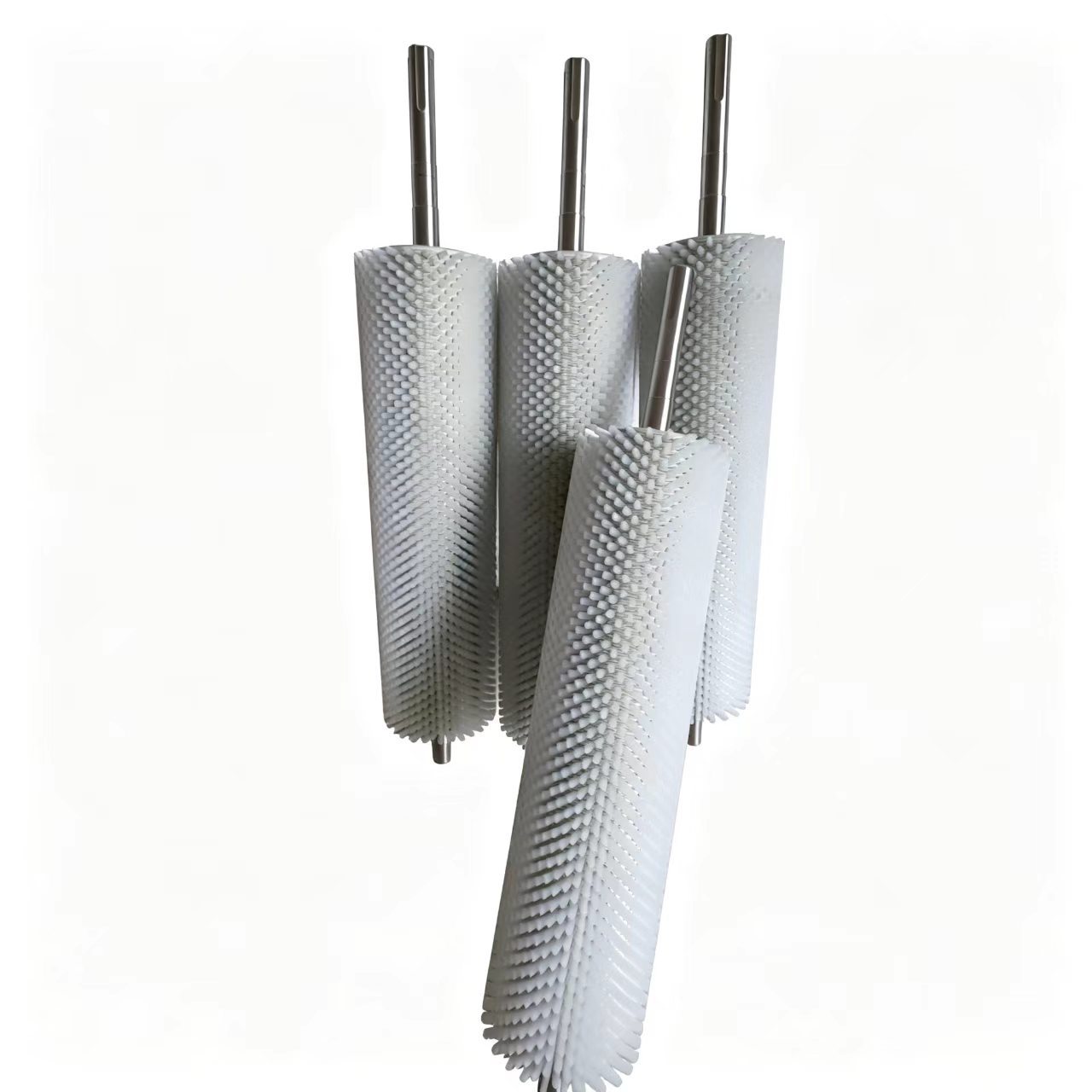
Product Overview: Zhonghui Ya RT-002
The RT-002 is a general-purpose tool brush roller designed for food processing equipment, including qianzhang machines, tofu skin (doupi) machines, and similar belt-cleaning and sheet-guiding stations. Its key characteristics are summarized below.
| Attribute | Detail |
|---|---|
| Brand | Zhonghui Ya |
| Model | RT-002 |
| Bristle material | Nylon |
| Bristle length | Customized to requirements |
| Roller specifications | Customized by material and size |
| Heat resistance | High-temperature resistant construction |
| Brush category | Tool brush |
| Place of origin | Tongcheng, Anhui, China |
| Imported? | No — domestically manufactured |
| Pricing | Quoted according to customer-selected specifications |
Why Nylon Bristles Are the Standard for Wet Soy Processing
Nylon is the most widely used filament in food machinery brushing for several practical reasons.
1. Resistance to moisture and warm operating conditions
A tofu skin line is constantly wet and often warm. Nylon absorbs very little water compared with natural fibers, so the bristles do not swell, soften, or develop odours. When paired with a heat-resistant roller body and tufting method, nylon filaments hold their stiffness through long shifts, which keeps the brushing pressure consistent from the first hour to the last.
2. Controlled flexibility
The key advantage of nylon is that its stiffness can be tuned. Filament diameter and bristle length together determine how much force the brush applies. For sheet-guiding positions, a finer, longer filament gives a gentle sweep. For belt-cleaning positions where dried residue must be lifted, a thicker, shorter filament is more effective. Because the RT-002 is built to order, the bristle length can be set to match the exact position on your machine.
3. Cleanliness and durability
Nylon filaments do not splinter or shed fibres the way some natural materials do, which matters when the product is destined for human consumption. They also resist the mild cleaning agents used during end-of-shift washdowns, so the roller can be maintained without being removed from the shaft.
Where the Roller Fits on Your Line
Although the RT-002 is described as a tool brush, its most common food-industry applications are:
- Belt and cloth cleaning — removing soy residue from the conveyor belt or pressing cloth so that the next cycle starts with a clean surface.
- Sheet guidance and tensioning — lightly pressing the qianzhang sheet against the drum so it feeds evenly without slipping.
- Anti-static and dust removal — clearing loose particles before the sheet enters the drying section.
- Edge trimming support — holding the sheet flat at the trimming station so the cut is clean and square.
Because every machine builder lays out its line differently, the mounting method (shaft diameter, end fittings, overall roller length) is normally matched to the customer's drawing rather than chosen from a fixed catalogue.
Customization Options You Should Confirm Before Ordering
Ordering a brush roller is mostly a matter of transferring a few measurements accurately. Before requesting a quotation, collect the following information:
- Overall roller length — the full face width, plus the shaft extension at each end.
- Shaft or core diameter — including any keyway, flat, or threaded end detail.
- Bristle length — normally measured from the base of the filament to the tip, and specified as a range if the brush must reach into a recess.
- Filament diameter — this determines stiffness; a thinner filament is softer, a thicker one is more aggressive.
- Brush pattern — straight tufts, spiral-wound, or a full-density strip, depending on whether the goal is sweeping or gentle contact.
- Core material — selected according to the temperature and the cleaning chemicals the roller will meet.
- Operating environment — maximum temperature, humidity, and whether the roller will be washed down in place.
Supplying these details up front shortens the sampling cycle considerably and reduces the risk of a roller that fits the machine but performs poorly.
Maintenance Practices That Extend Roller Life
Even a well-specified brush roller benefits from routine care:
- Rinse the filaments after each shift to prevent soy protein from drying in the tufts.
- Avoid high-pressure jets directed straight at the filament base, which can loosen tufts over time.
- Inspect for bent or matted bristles weekly; a matted section reduces cleaning efficiency across the whole width.
- Store spare rollers flat or on a rack, never resting on the bristles.
- Replace the roller when bristle length has worn noticeably, rather than increasing contact pressure to compensate.
Manufacturing Origin: Tongcheng, Anhui
The RT-002 is produced in Tongcheng, Anhui Province, a region with a long-established brush-making industry. Because the roller is domestically manufactured rather than imported, buyers gain two practical advantages: shorter lead times for customized specifications, and easier communication during the sampling stage, since drawings and tolerance questions can be resolved directly with the production team.
Domestic production also means that small-batch customization — a single roller in a non-standard length, for example — is economically reasonable, which is rarely the case with imported components that come in fixed sizes.
Who Should Consider This Roller
The RT-002 is a sensible fit for:
- Qianzhang and tofu skin producers replacing a worn or underperforming roller.
- Food machinery builders looking for a customizable brush component to integrate into new equipment.
- Small and mid-sized plants that need a heat-resistant nylon roller without the cost and lead time of an import.
- Operators whose existing roller is damaging the sheet and who need a softer, more precisely matched bristle length.
Ordering Summary
To request pricing for the Zhonghui Ya RT-002 nylon food machinery brush roller, prepare your roller length, shaft diameter, required bristle length, preferred filament thickness, and a note on operating temperature. Because pricing is based on the selected materials and dimensions, an accurate specification is the fastest route to a firm quotation and a roller that performs as expected on your qianzhang or tofu skin line.
Product details in this article refer to the Zhonghui Ya RT-002 tool brush roller, origin Tongcheng, Anhui, China; not imported. Specifications are customized to customer requirements.