

 CN

Fully automatic small and medium-sized corn noodle machine, commercial self-cooking rice noodle machine, Korean cold noodle machine, sweet potato noodle machine
Fully Automatic Corn Noodle Machine: A Stainless Steel Commercial Solution for Noodle Shops and Food Factories
Corn noodles, self-cooked rice noodles, Korean cold noodles, and sweet potato noodles all share one thing in common: they are difficult to produce consistently by hand at commercial volume. The Chengyi fully automatic corn noodle machine was built to solve that problem. As a mid-sized commercial extrusion unit with a stainless steel body, it gives noodle shops and food factories a reliable way to produce starch-based noodles in continuous runs — without a large production line, a large floor space, or a large investment.
This article walks through what the machine can produce, how the self-cooking extrusion process works, who it suits, and what you should know before placing an order for the Model 150 unit.
One Machine, Four Popular Noodle Categories
Although the product is commonly listed as a corn noodle machine, the same unit handles several starch and grain formulas. That flexibility is the main reason it appeals to small and mid-sized food businesses — one purchase covers multiple product lines instead of one.
- Corn noodles (玉米面条) — the machine’s primary application, using corn flour or corn starch blends.
- Self-cooked rice noodles (自熟米线) — rice-based noodles formed and gelatinized in a single extrusion pass.
- Korean cold noodles (朝鲜冷面) — chewy, elastic strands suited to chilled noodle dishes.
- Sweet potato noodles (红薯面条) — sweet potato starch formulas for hot pots, stir-fries, and cold dishes.
Because the die head determines strand shape and diameter, changing products is largely a matter of changing the die and adjusting the flour-to-water ratio. That makes the machine practical for businesses that want to test new products without buying new equipment each time.
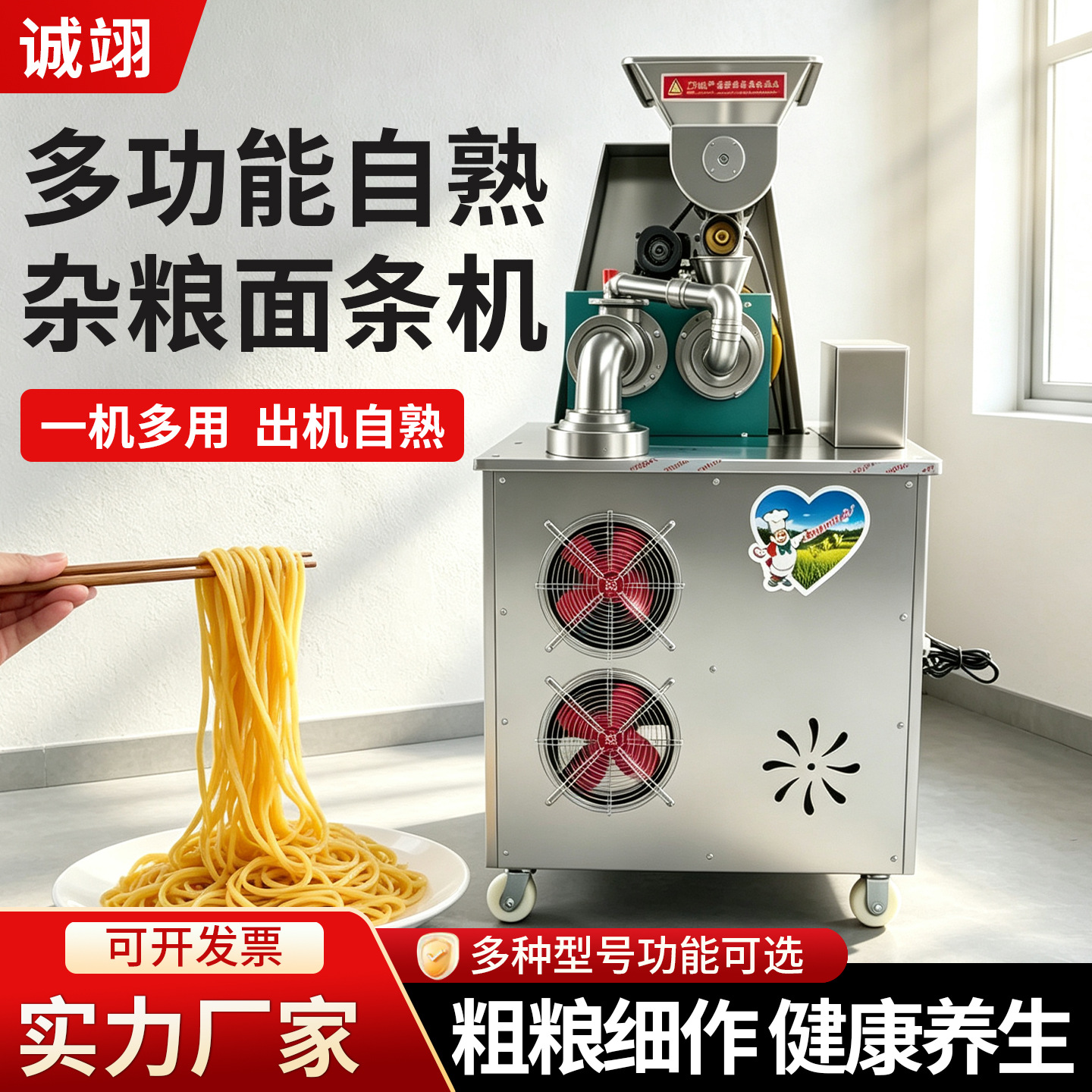
How the Self-Cooking (自熟) Extrusion Process Works
Traditional noodle production requires a separate cooking or steaming step to gelatinize the starch. A self-cooking machine handles this inside the barrel. As the screw pushes the dough forward, friction and controlled pressure generate heat, and the starch is partially gelatinized before the dough reaches the die. The strands that come out are already formed and partly cooked, which shortens the downstream process considerably.
In practice, this means:
- Fewer pieces of equipment on the production floor.
- Less manual handling between forming and cooking.
- More consistent texture from batch to batch than hand-made or semi-manual methods.
- Reduced labor requirements per kilogram of finished noodles.
For a noodle shop producing fresh product daily, or a food factory running scheduled batches, the time saved at this stage is usually the strongest argument for switching to an automatic unit.
Stainless Steel Body: Built for Daily Commercial Use
The machine’s body is constructed from stainless steel, which matters more in food production than it might first appear. Starch-based dough is wet, sticky, and acidic over time; mild steel and coated surfaces degrade quickly under those conditions. Stainless steel resists corrosion, cleans down more easily, and holds up to the repeated washdowns that any food-grade operation requires.
It also affects hygiene compliance. Smooth stainless surfaces leave fewer places for residue to accumulate, which simplifies daily cleaning and supports the kind of inspection standards that food factories are held to. For a noodle shop, the benefit is simpler: a machine that still looks and performs the same after a year of daily use.
Who This Machine Is Designed For
The manufacturer specifies two primary use cases — noodle restaurants (面馆) and food factories (食品厂) — and the design reflects both.
Noodle Shops and Restaurants
A mid-sized automatic machine lets a shop produce its own fresh noodles on site rather than buying in pre-made product. That gives control over recipe, freshness, and cost per bowl, and it opens the door to signature items — a house corn noodle, a sweet potato noodle special — that a competitor buying wholesale cannot easily copy.
Food Factories and Processing Workshops
For small and mid-scale food factories, the Model 150 sits in a useful gap: more output and consistency than manual or semi-manual equipment, without the capital cost and footprint of a full industrial line. It works well as a dedicated line for one product or as a flexible unit for short runs across several starch noodle types.
Small-Investment Startups
The product is explicitly positioned as a small-investment (小额投资) entry into noodle production. For entrepreneurs testing a local market, a single machine plus a work surface and drying space is enough to start producing and selling. Capacity can be expanded later by adding units rather than replacing the first one.
Key Specifications at a Glance
| Item | Detail |
|---|---|
| Brand | Chengyi (诚翊) |
| Product name | Fully automatic corn noodle machine (also listed as self-cooked rice noodle machine, Korean cold noodle machine, sweet potato noodle machine) |
| Model | 150型 (Model 150) — deposit listing |
| Body material | Stainless steel |
| Operation | Fully automatic extrusion with self-cooking (自熟) process |
| Applications | Corn noodles, rice noodles, Korean cold noodles, sweet potato noodles |
| Suitable for | Noodle restaurants, food factories, small-investment startups |
| After-sales service | One-year warranty |
| Primary sales channel | eBay |
| Main sales region | China |
| Cross-border export exclusive source | No |
Operation and Daily Maintenance
The machine is designed to be run by ordinary kitchen or production staff, not specialist technicians. A typical daily routine looks like this:
- Preparation: mix the flour or starch blend to the required moisture level.
- Startup: switch on, allow the barrel to reach operating temperature, then begin feeding dough.
- Production: extruded strands are cut to length and moved to the next stage — packing fresh, cooling, or drying.
- Shutdown and cleaning: disassemble the die and screw section, flush and wash down, dry before reassembly.
Cleaning discipline is the single biggest factor in machine lifespan. Starch residue left in the barrel or die overnight hardens and can affect both output quality and mechanical wear. A ten-minute end-of-shift routine prevents most of the problems owners run into.
Warranty and After-Sales Support
The unit ships with a one-year warranty, covering the machine against manufacturing defects during normal commercial use. For a business that depends on the machine daily, that warranty is not a marketing detail — it is the buffer that protects a production schedule in the first year, when most faults would surface.
Before ordering, confirm with the seller which components are covered, how spare parts such as dies and screws are supplied, and what the process is for a warranty claim. Getting those answers in writing at the point of purchase saves considerable friction later.
Ordering the Model 150 Unit
The Model 150 is currently offered on a deposit (定金) basis. This is standard practice for commercial food machinery: the deposit reserves the unit and confirms the configuration, and the balance is settled before dispatch. Two points are worth confirming with the seller before you pay:
- The exact deposit amount and the remaining balance, plus delivery costs to your location.
- The die specifications included as standard, and the cost of additional dies if you plan to produce more than one noodle type.
Because the machine is primarily sold within China and is not a cross-border export exclusive product, buyers outside China should ask directly about shipping arrangements, voltage configuration, and documentation before committing.
Frequently Asked Questions
Can one machine really produce corn, rice, Korean cold, and sweet potato noodles?
Yes. The extrusion and self-cooking mechanism is the same; what changes is the flour or starch formula and the die used. Different products need different moisture ratios and die specifications, which is why it is worth purchasing the relevant dies at the same time as the machine.
Is this suitable for a home kitchen?
It is a commercial-grade unit intended for noodle restaurants, food factories, and small production startups. It is designed for continuous daily output rather than occasional home use.
Will I need additional equipment to start selling?
Most operators add a mixing area, a cutting or packing station, and either a cooling rack or drying setup depending on whether they sell fresh or dried noodles. The machine handles forming and self-cooking; everything downstream depends on your product format and sales channel.
Where is the machine sold?
The primary downstream platform is eBay, with the main sales region being China. Buyers should verify current availability and shipping terms with the seller at the time of ordering.
Final Thoughts
The Chengyi automatic corn noodle machine is a practical answer to a specific commercial problem: producing starch-based noodles at consistent quality and volume, without a large production line or a large capital outlay. Stainless steel construction, a self-cooking extrusion process, four supported noodle types, and a one-year warranty make it a sensible first machine for a noodle shop expanding into in-house production or a small factory building a dedicated starch noodle line.
If your business sells corn noodles, rice noodles, Korean cold noodles, or sweet potato noodles, and you are currently limited by manual production, the Model 150 is worth a close look — starting with a conversation with the seller about deposit terms, dies, and delivery.