

 CN

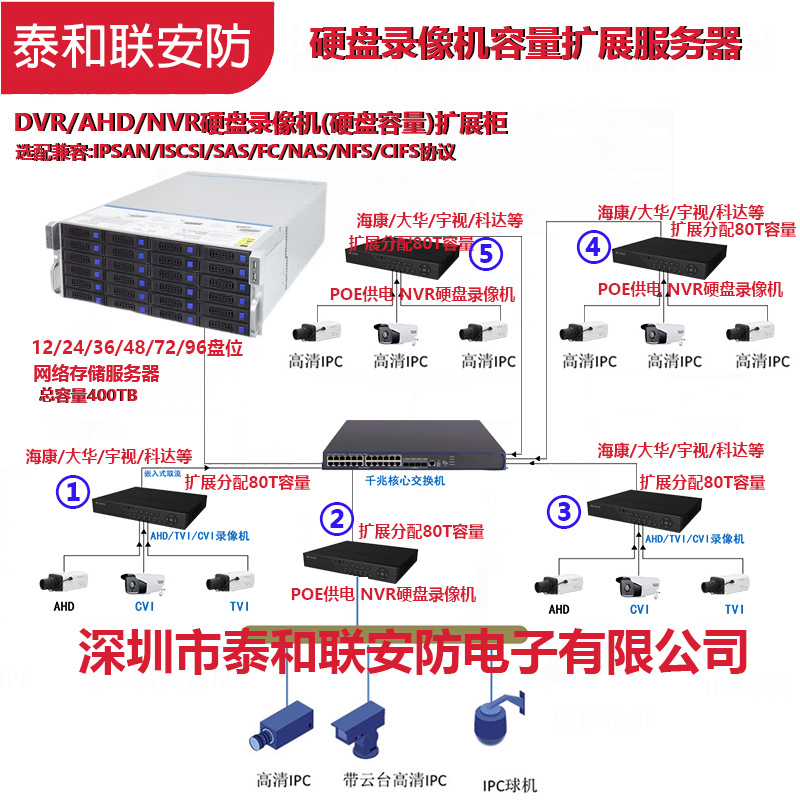
DVR/AHD/SDi/NVR hard disk video recorder capacity expansion cabinet storage server 24/48/72 disk positions
If you are building a control room, command center, retail chain monitoring hub, or any surveillance project that needs dozens of camera feeds displayed across multiple screens at the same time, a reliable decoder matrix is the backbone of the whole installation. The Multi-Channel HDMI HD Video Surveillance Decoder Matrix (DS-6A01UD / 6A04UD / 6A08UD) is designed exactly for this job — combining high-density decoding, multi-format video outputs, and built-in splicing control in a single rugged chassis.
What Is a Video Surveillance Decoder Matrix?
A decoder matrix takes encoded network video streams from IP cameras, NVRs, or streaming encoders and converts them back into uncompressed video signals for display on monitors, video walls, and TV screens. Unlike a simple decoder, a matrix unit can route different channels to different displays simultaneously, so operators can watch many sources at once without juggling multiple standalone boxes.
This model family goes a step further by integrating splicing and screen control directly into the chassis, meaning the same device that decodes your streams can also manage a multi-screen layout — reducing hardware count, cabling complexity, and rack space.
Key Highlights of the DS-6A01UD / 6A04UD / 6A08UD
- 16 HDMI outputs — drive multiple full-HD displays from a single unit, ideal for control room walls and multi-screen monitoring desks.
- 8 BNC outputs — legacy analog compatibility keeps existing CCTV monitors and broadcast equipment in service.
- 48 VGA outputs — exceptional flexibility for retrofitting older displays into a modern IP-based system.
- 16 audio outputs — pair video channels with independent audio for monitoring stations and public address integration.
- 8 alarm inputs and 8 alarm outputs — connect sensors, door contacts, or PIR detectors and trigger external devices automatically.
- Built-in splicing and screen control — the 2-screen HD decoder matrix supports combined multi-screen layouts without an extra controller.
- 8 input interfaces and 1 network interface — straightforward integration into existing IP surveillance networks.
- Wide operating temperature of -20°C to 75°C — stable performance in equipment rooms, outdoor cabinets, and poorly ventilated enclosures.
- Low 45W power consumption — energy-efficient operation for 24/7 continuous use.
- External 220V power supply — easier maintenance and replacement without opening the chassis.
Technical Specifications at a Glance
| Parameter | Specification |
|---|---|
| Model Number | DS-6A01UD / 6A04UD / 6A06UD / 6A08UD |
| Product Type | 2-Screen HD Decoder Matrix with Built-in Splicing Control |
| HDMI Outputs | 16 |
| BNC Outputs | 8 |
| VGA Outputs | 48 |
| Audio Outputs | 16 |
| Input Interfaces | 8 |
| Network Interface | 1 |
| Alarm Input / Output | 8 / 8 |
| Stream Merging (Multiplex Decoding) | Not supported |
| Wi-Fi | Not supported (wired network only) |
| Power Supply | External, 220V |
| Power Consumption | 45W |
| Operating Temperature | -20°C to 75°C |
| Operating Humidity | 35% |
| Dimensions | 450 mm |
| Weight | 22.3 kg |
| Place of Origin | China |
| Brand | Other |
Why 16 HDMI Outputs Matter for Surveillance Projects
Most mid-range decoder boxes top out at four or eight HDMI ports. When a control room needs twelve, sixteen, or more display zones, engineers usually end up stacking multiple units and adding a separate video wall controller. This matrix eliminates that problem: sixteen HDMI outputs let you assign dedicated screens to specific camera groups — perimeter cameras on one row, cashier lanes on another, parking areas on a third — while keeping everything under one management interface.
Combined with the 48 VGA outputs, the unit also supports phased upgrades. You can keep analog and VGA monitors running during the migration to IP, then swap displays out over time without replacing the decoder.
Built-In Splicing Control: Fewer Boxes, Less Wiring
Splicing control is normally a separate purchase. Here it is integrated into the decoder, allowing multiple physical screens to act as one logical canvas. For a two-screen setup, that means an operator can push a single camera feed across both panels, split the canvas between two camera groups, or run a picture-in-picture layout — all from the same device that performs decoding.
The practical result is a shorter bill of materials: no dedicated splicing controller, no extra matrix switcher, and fewer points of failure in a 24/7 installation.
Alarm Integration for Proactive Monitoring
With eight alarm inputs and eight alarm outputs, the decoder can sit at the center of an event-driven surveillance workflow. Motion detectors, glass-break sensors, or door contacts can be wired into the alarm inputs, and the unit can trigger external devices through the alarm outputs — strobes, buzzers, locks, or relays that notify staff. In perimeter security and unattended site monitoring, this turns passive recording into active response.
Designed for Harsh and Continuous Operation
The -20°C to 75°C operating range is unusually wide for a decoder of this class. Equipment closets, warehouse mezzanines, transport hubs, and outdoor cabinets often exceed the comfortable 0–40°C window assumed by consumer-grade hardware. A 45W power draw also means less heat generation and lower electricity costs over a multi-year deployment, while the external 220V power supply simplifies servicing — a failed PSU can be swapped in minutes without dismantling the rack.
At 450 mm wide and 22.3 kg, the chassis is built for fixed rack or shelf mounting in a permanent control room rather than portable use.
Typical Applications
- City and traffic command centers — decode dozens of road camera streams onto a multi-screen wall.
- Industrial and campus security rooms — monitor gates, production floors, and perimeter zones simultaneously.
- Retail chains and shopping malls — distribute feeds from multiple store areas to loss-prevention desks.
- Bank branches and data centers — high-reliability monitoring with alarm-triggered response.
- Transportation hubs — airports, stations, and ports requiring 24/7 video visibility.
- System integrators and retrofits — mixed HDMI, BNC, and VGA environments where legacy equipment must stay online.
What This Unit Does Not Do
Transparency matters when specifying hardware. This decoder does not support stream merging (multiplex decoding), and it has no Wi-Fi — all connectivity is wired through the single network interface. Projects requiring wireless backhaul or combined multi-stream decoding should plan for separate equipment. For straightforward wired decoding with high output density, however, these omissions keep the design focused and the cost predictable.
Selection Tips Before You Buy
- Count your displays first. Confirm whether your HDMI screens alone are sufficient or whether BNC and VGA monitors must also be supported.
- Check your camera encoding format. Verify stream compatibility with your NVR or IP camera platform before ordering.
- Plan rack space and power. Allow for a 450 mm chassis, 22.3 kg weight, and a dedicated 220V external supply.
- Map alarm devices early. Decide which sensors connect to the eight alarm inputs and which external devices the eight alarm outputs will drive.
- Confirm environmental conditions. Even with the wide -20°C to 75°C range, keep humidity near the rated 35% and ensure adequate airflow.
Frequently Asked Questions
How many screens can this decoder matrix drive?
It provides 16 HDMI outputs, 8 BNC outputs, and 48 VGA outputs. The built-in splicing control is specified for a 2-screen high-definition layout, and additional displays can be assigned individual channels.
Does it support wireless connections?
No. Wi-Fi is not supported. The unit connects to the surveillance network through its single wired network interface.
Can it combine multiple streams into one image?
Stream merging (multiplex decoding) is not supported on this model. Each channel is decoded independently.
What is the power requirement?
An external 220V power supply is used, with total power consumption of 45W — economical for continuous 24/7 operation.
Is it suitable for outdoor or unheated equipment rooms?
Yes. The rated operating temperature spans -20°C to 75°C, making it suitable for equipment cabinets, warehouses, and transport facilities where temperatures fluctuate widely.
Final Thoughts
The DS-6A01UD / 6A04UD / 6A08UD multi-channel HDMI HD video surveillance decoder matrix targets a very specific but very common problem: getting many camera feeds onto many screens, reliably, without building a tower of single-purpose boxes. With 16 HDMI outputs, 48 VGA outputs, 8 BNC outputs, 16 audio channels, 8 alarm inputs and outputs, integrated splicing control, and a -20°C to 75°C operating range, it delivers the output density and environmental tolerance that professional surveillance installations demand — at a modest 45W.
For integrators planning a control room, upgrading analog monitoring infrastructure, or standardizing decoder hardware across multiple sites, this unit is a practical, cost-controlled choice worth shortlisting.