

 CN

128-channel and 256-channel video surveillance network storage server 24/48/72-bit disk array onvif
Modern video surveillance is no longer just about cameras. The real challenge sits behind the lens: where do hundreds of high-resolution video streams go, how long do they stay available, and how do you retrieve them instantly when an incident occurs? For system integrators, distributors, and enterprise security teams, the answer increasingly lies in purpose-built IoT cloud storage servers — disk arrays engineered specifically for continuous recording rather than general-purpose IT workloads.
This guide takes an in-depth look at the THL-V200CVR24V6 and THL-V200CVR48V6 series, a family of rack-mountable video surveillance IoT cloud storage servers available in 24, 48, and 72-bay configurations, designed for ONVIF and GB28181 environments.
Why Video Surveillance Storage Deserves Its Own Hardware
A camera that records 24 hours a day writes data continuously. Over a year, that single stream can generate terabytes of footage — and most projects run dozens or hundreds of cameras at once. General-purpose servers are not optimized for this pattern. They tend to prioritize random read/write performance, run operating systems that consume resources on non-essential tasks, and often lack the thermal headroom and disk management features required for round-the-clock video ingestion.
A dedicated video storage appliance solves these issues by focusing on three priorities:
- Continuous write endurance — the storage subsystem is tuned for sustained, sequential video writes across many channels simultaneously.
- Protocol-native integration — the server speaks the same languages as the cameras, eliminating complex middleware.
- Scalable bay counts — capacity grows with the project instead of forcing an early replacement cycle.
Product Overview: THL-V200CVR Series Video Storage Server
The THL-V200CVR series is a rack-mounted video surveillance IoT cloud storage server manufactured in China, offered in multiple chassis heights and disk bay configurations to match projects ranging from a single building to a multi-site campus. It accepts 220V power input and supports SAS and SATA disk interfaces, giving integrators flexibility in choosing enterprise-grade drives from multiple vendors.
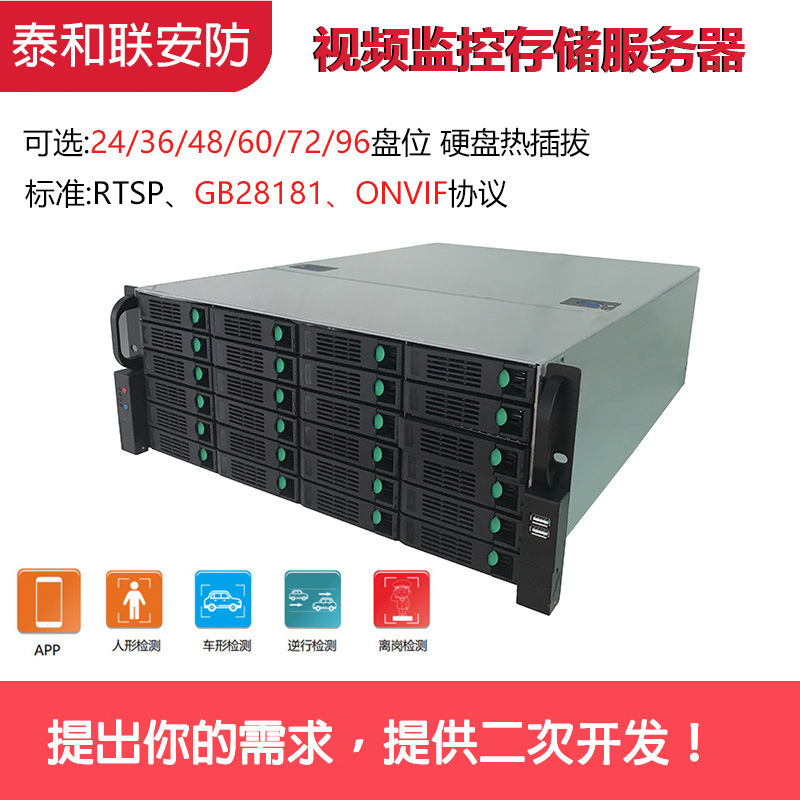
Key Technical Specifications at a Glance
| Parameter | Specification |
|---|---|
| Product Type | Video surveillance IoT cloud storage server / disk array |
| Model Numbers | THL-V200CVR24V6, THL-V200CVR48V6 |
| Disk Bays | 24 / 48 / 72 bay options |
| Chassis Heights | 2U / 4U / 6U / 8U / 12U / 16U / 18U / 24U |
| Dimensions | 650 × 450 × 177 mm |
| Weight | 26.9 kg |
| Disk Interface | SAS / SATA |
| Network Protocols | ONVIF / RTSP / GB28181 |
| Video Channels | 100-channel video access license (V24) |
| Recording Performance | Full-day continuous recording |
| Image Performance | 2M |
| Power Supply | 220V |
| Rated Power Consumption | 450W / 550W / 650W / 750W (by configuration) |
| Operating Temperature | -40°C to +85°C |
| Operating Humidity | 20% – 80% |
| Place of Origin | China |
Choosing the Right Bay Configuration
Bay count is the single most consequential decision in a video storage project, because it directly determines recording retention and future expansion room. The THL-V200CVR series offers three main paths:
24-Bay Systems
Ideal for mid-sized deployments such as commercial buildings, retail chains, schools, and industrial parks. With 24 bays, a single appliance can host a substantial number of high-definition streams while maintaining a comfortable retention window. The 2U variant keeps rack space minimal, making it a practical choice where floor space and cabinet height are constrained.
48-Bay Systems
The 48-bay model (THL-V200CVR48V6) is built for larger campuses, city-level monitoring nodes, and data aggregation points where 100-channel video access is routinely saturated. Doubling the bay count extends retention or increases stream density without adding a second management interface.
72-Bay Systems
For centralized storage rooms, telecom-grade facilities, and multi-tenant cloud storage scenarios, a 72-bay array delivers the highest density in the family. These configurations pair naturally with taller chassis options such as 16U, 18U, and 24U, where drive servicing, airflow, and cable management can be handled efficiently.
Protocol Compatibility: ONVIF, RTSP, and GB28181
Compatibility is where many storage projects quietly fail. A server that only supports proprietary camera brands creates vendor lock-in and complicates mixed-vendor installations. The THL-V200CVR series avoids this by supporting three widely adopted standards:
- ONVIF — the international interoperability standard, enabling direct integration with IP cameras and NVRs from a wide range of manufacturers.
- RTSP — real-time streaming protocol support for live viewing and on-demand playback from third-party clients.
- GB28181 — the Chinese national standard for surveillance networking, essential for government, public safety, and large infrastructure projects that require platform-level registration and cascading.
With 100 authorized video channels per V24 license, integrators can onboard a full camera group without purchasing separate channel packs for each stream.
Built for Extreme Environments
One of the most notable characteristics of this platform is its operating temperature range of -40°C to +85°C. Surveillance equipment is frequently installed in locations that are far from climate-controlled: unheated warehouses, roadside cabinets, rooftop equipment rooms, and industrial sites with heavy machinery. Hardware rated for this range reduces the risk of thermal shutdowns and extends service life in harsh conditions.
Operating humidity of 20% to 80% covers the vast majority of indoor and sheltered outdoor installations, while the rack-mount form factor and standard 220V power input align with typical electrical infrastructure in most markets.
Power Consumption and Deployment Planning
Rated power consumption ranges from 450W to 750W depending on the configuration and disk load. When planning a deployment, it is worth factoring in:
- Circuit capacity — confirm that rack PDUs and upstream breakers can handle the combined load of the storage array plus network switches.
- Cooling — sustained video recording generates continuous heat; plan airflow in the rack accordingly, particularly for high-bay-count chassis.
- Redundancy — for mission-critical sites, consider dual power feeds and UPS protection to prevent write interruptions during outages.
Typical Application Scenarios
The combination of high bay density, broad protocol support, and wide temperature tolerance makes these storage servers suitable for a diverse set of projects:
- Smart city and municipal surveillance — GB28181 registration into city-level management platforms.
- Industrial and manufacturing campuses — continuous recording in high-temperature production environments.
- Retail and hospitality chains — centralized storage across multiple branches with ONVIF camera compatibility.
- Transportation hubs — airports, rail stations, and logistics centers requiring long retention periods.
- Cloud and colocation storage nodes — multi-tenant video storage with scalable bay counts.
- Education and healthcare — campus-wide recording with strict retention and retrieval requirements.
Selection Checklist for Integrators
Before finalizing a configuration, work through the following questions:
- How many cameras will be connected, and what is the target resolution and frame rate?
- What retention period does the client require — 30, 60, or 90 days?
- Which management platform will the server register with, and does it rely on GB28181 or ONVIF?
- What is the available rack space, and which chassis height fits it best?
- Are environmental conditions within the rated -40°C to +85°C range, or is additional enclosure protection needed?
- What disk type and capacity will be used, and is SAS or SATA preferred for the project?
Final Thoughts
Video surveillance storage is infrastructure — it is rarely seen, but everything depends on it. The THL-V200CVR24V6 and THL-V200CVR48V6 series address the core requirements of professional deployments: high bay density across 24, 48, and 72-bay configurations, standard protocol support through ONVIF, RTSP, and GB28181, 100-channel video access licensing, full-day recording capability, and an operating temperature range that holds up in demanding environments.
For integrators and distributors building out surveillance projects at any scale, this platform offers a practical balance of density, compatibility, and durability — a storage foundation that keeps footage available when it matters most.