

 CN

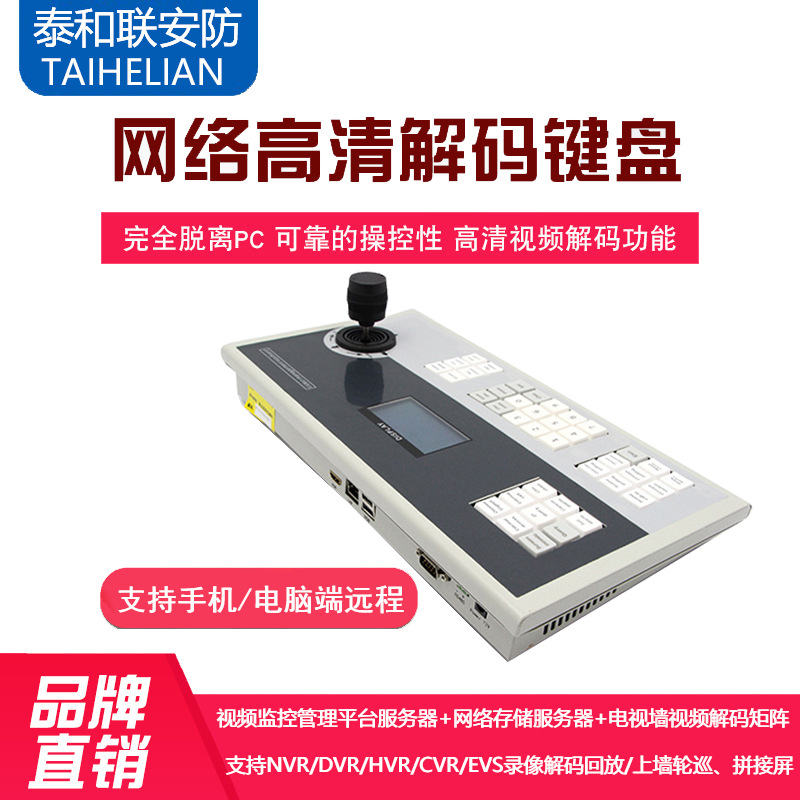
Brand-new network camera video surveillance keyboards DS-1100K(C) and DS-1200K (B)
Multi-Channel HDMI Video Surveillance Decoder Matrix DS-6A01UD / 6A04UD / 6A08UD: High-Density Monitoring Display with 16 HDMI, 48 VGA, and 8 BNC Outputs
As surveillance systems grow from a handful of cameras to dozens or even hundreds, the display side of the project often becomes the bottleneck. Operators need to see many video streams at once, switch layouts quickly, and push content onto large video walls without adding a rack full of standalone decoders. The DS-6A01UD / 6A04UD / 6A08UD multi-channel HDMI video surveillance decoder matrix is designed for exactly this situation: a single rack-mount chassis that combines multi-format video decoding, dual-screen high-definition display, and built-in splicing control in one integrated unit.
Manufactured in China and supplied under the DS-6A01UD / 6A04UD / 6A06UD / 6A08UD part numbering, this decoder matrix targets control rooms, transportation hubs, industrial parks, retail chains, and campus security centers that require dense, reliable multi-screen video output with 24/7 operation.
What a Decoder Matrix Actually Does for Your Control Room
A network decoder matrix receives compressed video streams from IP cameras, NVRs, or streaming platforms over the network and converts them back into uncompressed HDMI, VGA, and BNC signals for monitors and video walls. Instead of one decoder box per screen, a matrix chassis performs this conversion for many displays simultaneously and allows operators to assign, group, and rearrange video windows on the fly.
This model is positioned as a 2-screen high-definition decoder matrix with integrated splicing and control. That combination matters in practice: the same device that decodes the streams also manages how those streams are arranged across the screens, so a single management interface replaces what would otherwise be a decoder plus a separate video wall controller.
Core Specifications at a Glance
| Parameter | Specification |
|---|---|
| Product type | Multi-channel HDMI video surveillance decoder matrix |
| Models | DS-6A01UD / DS-6A04UD / DS-6A06UD / DS-6A08UD |
| Configuration | 2-screen HD decoder matrix with built-in splicing control |
| HDMI outputs | 16 |
| VGA outputs | 48 |
| BNC outputs | 8 |
| Audio outputs | 16 |
| Input interfaces | 8 |
| Alarm inputs / outputs | 8 / 8 |
| Network interface | 1 |
| Stream multiplexing (merged decoding) | Not supported |
| Wi-Fi | Not supported |
| Power supply | External, 220 V |
| Power consumption | 45 W |
| Dimensions | 450 mm |
| Weight | 22.3 kg |
| Operating temperature | -20 to 75 °C |
| Operating humidity | 35% |
| Place of origin | China |
Flexible Output Architecture: 16 HDMI, 48 VGA, and 8 BNC
The strongest argument for this unit is output density. With 16 HDMI outputs, the matrix can drive sixteen full-HD displays directly, which is enough to build a four-by-four video wall, populate a long control desk, or distribute feeds to multiple viewing rooms. For environments still running analog-era monitors or legacy VGA displays, the 48 VGA outputs provide a migration path that avoids wholesale hardware replacement, while the 8 BNC outputs let existing composite monitors and analogue recording equipment stay in service alongside modern IP infrastructure.
Mixing HDMI, VGA, and BNC in one chassis means a phased upgrade becomes realistic. New HDMI walls can be added floor by floor while older VGA and BNC positions continue working from the same decoder — no separate conversion hardware, no second management platform.
Built-In Splicing Control Without a Separate Video Wall Processor
Traditional video wall projects require a decoder for every screen plus a dedicated splicing controller to coordinate window layouts and synchronised output. This matrix folds both functions into one device. Operators can define window arrangements, map cameras to specific output ports, and adjust multi-screen layouts from the same control interface used for decoding.
The 2-screen HD matrix configuration is particularly well suited to small and medium control rooms where two independent display groups must be managed simultaneously — for example, a primary wall showing live perimeter cameras and a secondary wall showing access control, parking, and alarm-triggered feeds.
Audio and Alarm Integration
Video surveillance is rarely video alone. The 16 audio outputs align with the HDMI output groups, allowing audio from selected channels to be delivered to monitoring positions or public-address zones. In retail, banking, and transport environments, audio monitoring is often a compliance requirement rather than an optional extra.
The 8 alarm inputs and 8 alarm outputs provide a hardware bridge between the video system and third-party devices. Alarm inputs can be wired to door contacts, infrared detectors, or emergency buttons so that a triggered sensor forces the associated camera to a designated display. Alarm outputs can drive sirens, strobes, or relay-controlled access barriers, closing the loop between detection and response.
Designed for Harsh and Unattended Environments
Control equipment is often installed somewhere far from the comfortable front office — an equipment room without air conditioning, a roadside cabinet, a factory floor, or an unheated warehouse. The -20 to 75 °C operating temperature range gives this decoder matrix substantially more headroom than typical commercial-grade equipment, which usually stops at around 40 °C. That margin translates into stable operation through summer heat spikes and cold winter startups.
Power consumption is rated at 45 W, which is modest for a chassis driving this many outputs — an important consideration when dozens of devices share one equipment room and cooling capacity is limited. The external 220 V power supply keeps heat-generating conversion components outside the main chassis and simplifies replacement in the field.
Wired-First by Design
This is a deliberately wired device: one network interface, no Wi-Fi, and no merged-stream decoding. For security projects this is a feature rather than a limitation. A single dedicated network port keeps the decoder on an isolated surveillance VLAN, removes an obvious wireless attack surface, and simplifies network segmentation audits. The absence of merged decoding also means each channel is decoded independently, so a stream issue on one camera does not degrade the display of others.
Practical Deployment Scenarios
- Campus and industrial park security centres: 16 HDMI outputs feed a multi-screen wall, while VGA outputs serve guard posts and secondary monitoring rooms.
- Transportation hubs: Alarm inputs from emergency call points push the nearest camera to the operator's primary display automatically.
- Retail chains and shopping malls: BNC outputs keep legacy analogue monitors in service while HDMI drives new digital signage-style walls.
- Manufacturing and utilities: Wide temperature tolerance supports installation in production areas and remote substations.
- System integrators and retrofits: One chassis replaces a stack of single-channel decoders plus a separate splicing controller, reducing rack space and cabling.
Choosing Between the DS-6A01UD, 6A04UD, 6A06UD, and 6A08UD
The range is offered in several part numbers so that a project can be matched to its actual output count and control requirements. The model number should be confirmed against the required number of screens, the mix of HDMI, VGA, and BNC positions, and whether audio monitoring and alarm integration are needed at that location. Specifying the correct variant up front avoids paying for unused outputs on small sites while preserving headroom for larger walls.
Installation and Handling Notes
At 22.3 kg and 450 mm in depth, the unit is a genuine rack-mount chassis that warrants a two-person lift and a properly rated cabinet rail kit. Before powering up, confirm that the equipment room maintains humidity near the rated 35% level and that the external 220 V supply is on a protected circuit. Keep the single network port on a dedicated switch or VLAN, and document alarm input wiring at commissioning time — clearly labelled alarm terminations save hours during the first live incident.
Summary
The DS-6A01UD / 6A04UD / 6A08UD multi-channel HDMI video surveillance decoder matrix answers a specific and common problem: how to display many camera streams across many screens without accumulating a rack of single-purpose boxes. By combining 16 HDMI outputs, 48 VGA outputs, 8 BNC outputs, 16 audio outputs, 8 alarm inputs and outputs, and integrated splicing control in one 45 W chassis rated for -20 to 75 °C operation, it delivers high output density with the durability that real control rooms demand.
For integrators planning a new monitoring centre or upgrading a mixed analogue-digital site, this decoder matrix is a practical foundation — dense enough for a large video wall, flexible enough for legacy displays, and simple enough to keep the network architecture clean.