

 CN

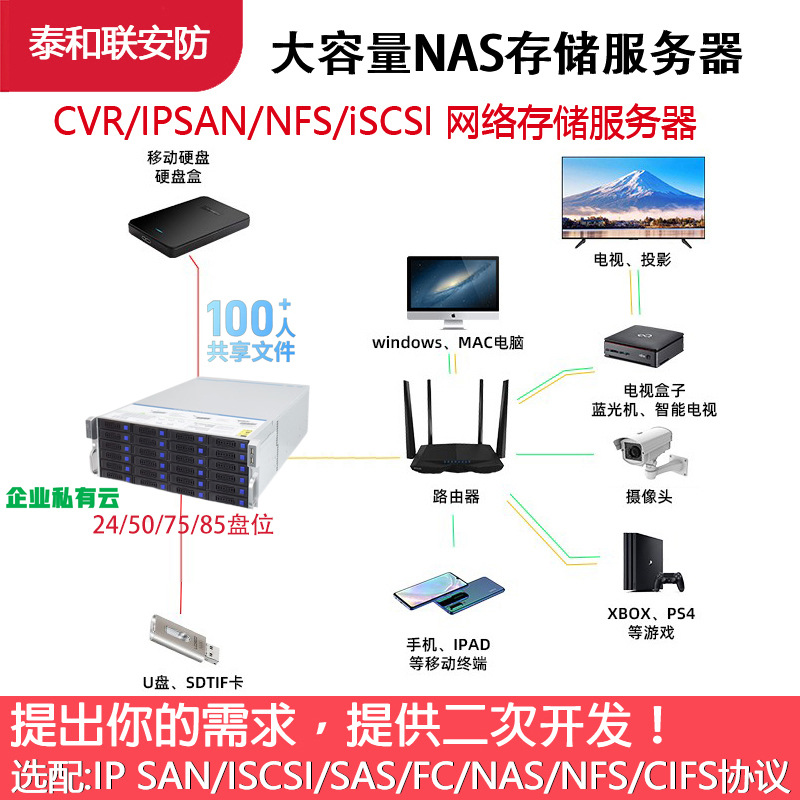
NAS disk array storage server video production and editing sharing 24/36/48/72 disk slots hot-swappable
As surveillance systems grow from a handful of cameras to dozens or even hundreds, the display side of the project becomes just as important as the recording side. Operators need to see the right camera on the right screen at the right moment — and they need that view to be stable, sharp and easy to reconfigure. The DS-6A01UD / 6A04UD / 6A08UD series of multi-channel HDMI HD video surveillance decoder matrices is built for exactly this job: taking networked video streams and turning them into a clean, controllable wall of HDMI and BNC displays with built-in splicing and display control.
What Is a Decoder Matrix and Why Does It Matter?
A decoder matrix sits between the network video recorder or video management platform and the monitors in a control room. Instead of connecting each camera directly to a screen — which becomes impossible once the camera count passes a certain point — the decoder receives streams over the network, decodes them, and distributes the resulting pictures across multiple HDMI and BNC outputs. Because the switching, splitting and window layout are handled inside the device, operators can change a layout in seconds without touching a single cable.
The DS-6A01UD / 6A04UD / 6A08UD family takes this concept further by integrating splicing and display control into the same chassis. That means one unit can handle both the decoding workload and the large-screen拼接 (splicing) logic, reducing the number of boxes in the rack and simplifying the whole signal chain.
Key Capabilities at a Glance
The product data describes a chassis that is clearly aimed at mid-to-large control rooms and multi-screen signage deployments:
- 16 HDMI outputs for high-definition display walls and operator monitors
- 8 BNC outputs for legacy analogue monitors and broadcast-style viewing
- Up to 48 VGA outputs for compatibility with existing display infrastructure
- 16 audio outputs so video and sound stay in sync across the wall
- 8 input interfaces and 1 network interface for source connectivity
- 8 alarm inputs and 8 alarm outputs for integration with sensors, sirens and access control
- Integrated splicing and display control — no separate controller required
- External 220 V power supply with a low 45 W power consumption
- Operating temperature of -20 to 75 °C and 35% working humidity
- 22.3 kg build weight in a 450 mm chassis
Detailed Technical Specifications
| Parameter | Specification |
|---|---|
| Product type | Multi-channel HDMI HD video surveillance decoder matrix |
| Model / Item No. | DS-6A01UD / 6A04UD / 6A06UD / 6A08UD |
| Configuration | 2-screen HD decoder matrix with built-in splicing and display control |
| HDMI outputs | 16 |
| BNC outputs | 8 |
| VGA outputs | Up to 48 |
| Audio outputs | 16 |
| Input interfaces | 8 |
| Network interfaces | 1 |
| Alarm inputs / outputs | 8 / 8 |
| Stream combining (合码) | Not supported |
| Wi-Fi | Not supported (wired network deployment) |
| Power supply | External, 220 V |
| Power consumption | 45 W |
| Operating temperature | -20 to 75 °C |
| Working humidity | 35% |
| Dimensions | 450 mm |
| Weight | 22.3 kg |
| Place of origin | China |
Where This Decoder Matrix Fits Best
1. Control Rooms and Security Operation Centres
With 16 HDMI outputs plus 8 BNC outputs, a single unit can drive a mixed display wall made up of large LCD panels and legacy monitors. Operators can keep an overview layout on the big screens while opening a full-resolution single-camera view on a workstation display — all from the same decoder.
2. Large-Screen Splicing Projects
Because splicing control is built in, the decoder matrix can be used as the display engine for a multi-panel video wall without adding a dedicated splicing processor. This reduces cabling, rack space and the number of potential points of failure, and it keeps layout changes in a single management interface.
3. Multi-Site and Campus Surveillance
Schools, industrial parks, logistics hubs and hospital campuses typically run dozens of cameras across several buildings. The 8 alarm inputs and 8 alarm outputs allow the decoder to react to perimeter sensors, door contacts and emergency buttons — for example, automatically bringing the relevant camera group to the foreground when an alarm is triggered.
4. Retail Chains and Transport Terminals
For environments that combine live monitoring with public information displays, the VGA and BNC outputs make it easy to reuse existing screens rather than replacing them. That lowers the upgrade cost of a display refresh considerably.
Deployment Notes for Installers and Integrators
Power planning. The unit uses an external 220 V power supply and draws only 45 W, so it places a very light load on a UPS-backed rack. A small UPS can keep the decoder running for a long time during an outage, which matters in control-room applications.
Thermal and environmental conditions. The stated operating range of -20 to 75 °C covers almost every indoor scenario, from air-conditioned equipment rooms to unconditioned cabinets in warmer climates. Working humidity is rated at 35%, so in humid regions it is worth pairing the unit with a sealed enclosure or dehumidified rack rather than mounting it in a wet plant room.
Network design. There is a single network interface and no Wi-Fi support — which is normal for professional surveillance hardware. Plan for a wired connection to the video management switch, and if the site uses VLAN separation, give the decoder its own dedicated port with sufficient bandwidth for the number of concurrent streams it will display.
Physical installation. At 22.3 kg in a 450 mm chassis, the unit should be installed by two people on a suitably rated rack shelf or in a fixed cabinet. Leave clearance at the front and rear for airflow and for the HDMI, VGA and BNC cable bundles, which add meaningful depth behind the chassis.
Understand the stream-combining limitation. The device does not support stream combining (合码). When designing the decoding plan, budget stream decoding at the camera level rather than relying on combined streams from the platform. This affects how many cameras can be shown per display at the required resolution, so confirm your expected layout density before finalising the bill of materials.
Choosing Between DS-6A01UD, 6A04UD, 6A06UD and 6A08UD
The four item numbers in the family share the same platform and the same integrated splicing control, but differ in output configuration and therefore in the number of screens they can manage directly. As a rule of thumb:
- Choose the smallest configuration in the family when you are feeding two screens with a limited number of cameras and want to keep the budget tight.
- Step up within the family as the number of monitors, the size of the video wall or the number of independent viewing groups grows.
- Where legacy analogue monitors must be kept, favour the configuration with the fullest BNC output capacity.
- Where existing VGA displays and projectors dominate the room, prioritise the VGA output capacity.
Because the underlying decoding and splicing architecture is shared, moving between models does not change the operator experience — the interface, layout control and alarm handling stay consistent across a mixed fleet.
Why the Integrated Splicing Design Saves Money
Traditional decoder-plus-splicer architectures require two devices, two power feeds, two management interfaces and twice the rack space. By combining decoding, matrix switching and splicing control in one 450 mm chassis, this series removes a layer of hardware from the project. The savings come in three places: lower equipment cost, less cabling and labour during installation, and simpler maintenance afterwards, since the whole display chain can be diagnosed from a single device.
Frequently Asked Questions
Can this decoder matrix be used without a separate splicing processor?
Yes. Splicing and display control are built into the unit, so it can drive a spliced video wall directly.
Does it support wireless connection?
No. Wi-Fi is not supported; the unit connects to the surveillance network through its wired network interface.
What is the power consumption?
45 W, supplied through an external 220 V power adapter.
Can it trigger external devices on an alarm?
Yes. There are 8 alarm inputs and 8 alarm outputs, allowing the decoder to receive sensor signals and drive sirens, relays or other notification hardware.
How heavy is the unit and how much rack space does it need?
The unit weighs 22.3 kg and measures 450 mm. Plan the rack or cabinet installation accordingly, and always allow rear clearance for cable bundles.
Final Thoughts
The DS-6A01UD / 6A04UD / 6A06UD / 6A08UD multi-channel HDMI HD video surveillance decoder matrix is a practical, well-specified building block for anyone designing a control room, a spliced video wall or a multi-screen monitoring station. With 16 HDMI outputs, 8 BNC outputs, up to 48 VGA outputs, 16 audio channels, 8 alarm inputs and outputs, an integrated splicing controller and a modest 45 W power draw, it covers the majority of mid-to-large display requirements in a single 450 mm chassis. For integrators who want fewer boxes, simpler cabling and a consistent operator experience across a project, this series is worth shortlisting.