

 CN

Brand-new network camera video surveillance keyboards DS-1100K and DS-1600K B
Multi-Channel HDMI HD Video Surveillance Decoder Matrix: A Practical Control-Room Solution
As surveillance systems grow from a handful of cameras to dozens or hundreds, the bottleneck is rarely the camera any more. It is the decoding and display layer. Operators need every feed on screen at the right moment, at the right size, without the lag or tearing that comes from overloading a general-purpose PC. The DS-6A01UD / 6A04UD / 6A08UD series is a dedicated decoder matrix built for exactly this job: turning compressed network streams into clean, stable HDMI and VGA video walls inside a single rack-mountable chassis.
This article looks at what the unit actually does, how its interfaces are laid out, and where it fits best in real deployments — from small monitoring rooms to multi-screen command centres.
One Box, Many Screens
The first thing to understand about this decoder matrix is that it is not a simple decoder. It combines three functions that are normally purchased as separate devices:
- Multi-channel video decoding — network streams from IP cameras and NVRs are decoded into baseband video for direct display.
- Matrix switching — any input stream can be routed to any output port, so operators can build their own screen layouts on the fly.
- Video wall splicing — built-in splice control lets several physical screens behave as one logical canvas, which is what makes a two-screen or larger display wall possible without an extra controller.
Because decoding, switching and splicing live in the same chassis, the signal path stays short. There is no daisy chain of third-party boxes to configure and no extra point of failure between the camera stream and the screen.
Interface Layout: Designed for Real Control Rooms
The port count is where this unit separates itself from consumer-grade decoders. Sixteen HDMI outputs and forty-eight VGA outputs are available for display, giving integrators the freedom to mix modern HDMI panels with existing VGA monitors — a very practical advantage when upgrading a room that already has installed cabling.
On the audio side, sixteen audio outputs allow the decoder to carry audio alongside video for channels that need it, so critical zones can be monitored by sound as well as by picture. Eight BNC outputs are also provided for legacy analogue display or loop-through requirements.
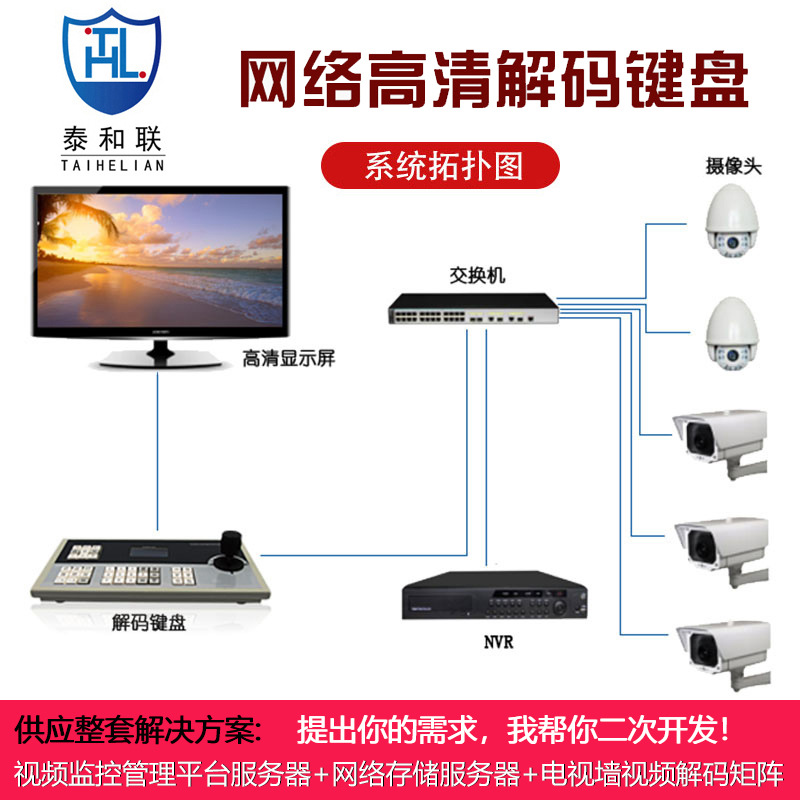
For input and control, the unit offers eight input interfaces and a single network interface. The network port is the main data path — the decoder pulls streams across the LAN, which keeps the whole system on standard IP infrastructure rather than requiring dedicated video cabling. Eight alarm inputs and eight alarm outputs make the decoder part of the security logic rather than just a display device: sensor trips and alarm contacts can trigger layout changes, and the decoder can raise its own outputs to notify other equipment.
Built for Continuous Duty
A decoder in a monitoring room typically runs 24 hours a day, every day. That makes thermal and power design more important than raw specification sheets suggest. This model is rated for operation between -20°C and 75°C, a range far wider than a typical office environment, which gives headroom in plant rooms, container-style security cabins and rooftop equipment areas where temperatures swing significantly.
Working humidity is rated at 35%, and power comes from an external 220V supply. Keeping the PSU outside the chassis reduces heat inside the box and simplifies replacement if a supply ever fails, without taking the whole decoder offline for a bench repair. Power consumption is listed at 45W, which is modest for a device driving this many outputs and keeps the load on a UPS within easy planning limits.
The unit weighs 22.3 kg and measures 450 mm across, so it is a rack-oriented device. Plan for appropriate support and ventilation clearance when mounting it, and allow space at the rear for the HDMI, VGA, BNC and alarm terminations.
What It Is Not
Being clear about limitations saves integration time. This decoder does not support stream merging, so it should be specified for deployments where each input stream is decoded and displayed as an independent source rather than combined at the device. It also has no Wi-Fi capability, which is a deliberate design choice: video walls belong on wired networks for stability and bandwidth reasons. Every stream the decoder handles should reach it over cabled Ethernet through the single network interface, so switch capacity and VLAN design on the network side deserve as much attention as the decoder itself.
Specifications at a Glance
| Parameter | Value |
|---|---|
| Model | DS-6A01UD / 6A04UD / 6A08UD (also listed as 6A06UD) |
| Product type | Multi-channel HD video surveillance decoder matrix |
| Configuration | 2-screen HD decoder matrix with built-in splicing control |
| HDMI outputs | 16 |
| VGA outputs | 48 |
| BNC outputs | 8 |
| Audio outputs | 16 |
| Input interfaces | 8 |
| Network interfaces | 1 |
| Alarm inputs / outputs | 8 / 8 |
| Stream merging | Not supported |
| Wi-Fi | Not supported |
| Power | External 220V |
| Power consumption | 45W |
| Operating temperature | -20°C to 75°C |
| Operating humidity | 35% |
| Dimensions | 450 mm |
| Weight | 22.3 kg |
| Place of origin | China |
Where This Decoder Fits Best
Three deployment patterns suit this hardware particularly well:
- Two-screen control desks. With built-in splice control and enough outputs to drive a large wall, the decoder replaces a separate video-wall controller for two-panel layouts.
- Mixed-signal retrofit projects. The combination of HDMI and VGA outputs means existing analogue monitors can stay in service while new HDMI panels are added, spreading upgrade cost across phases.
- Alarm-driven monitoring. With eight alarm inputs and eight alarm outputs, the decoder can be wired directly into door contacts, perimeter sensors or existing alarm panels so that layouts respond automatically to events.
Deployment Checklist Before You Buy
- Count your displays and confirm the split between HDMI and VGA monitors.
- Confirm every camera stream can reach the decoder over a wired network, and size the switch uplink accordingly.
- Check that your design does not rely on stream merging at the decoder.
- Plan rack space, rear cable clearance and airflow around a 22.3 kg, 450 mm chassis.
- Verify your site temperature stays within -20°C to 75°C and humidity levels match the 35% specification.
- Map out which alarm inputs and outputs will be used, and label them before commissioning.
Conclusion
The DS-6A01UD / 6A04UD / 6A08UD decoder matrix is aimed at buyers who need a large number of decoded outputs in a single, purpose-built device rather than a stack of PCs and adapters. Its strengths are straightforward: high output density across both HDMI and VGA, integrated splicing for multi-screen walls, alarm connectivity that makes it part of the security system, and a wide operating temperature range that suits less forgiving installation environments. Understand its boundaries — no stream merging, wired network only — and it becomes a reliable, long-service backbone for a surveillance display system.