

 CN

Network decoder matrix DS-B20-S14-DA, DS-B20-S14-A
Multi-Channel HDMI HD Video Surveillance Decoder Matrix: A Complete Guide to the DS-6A01UD / 6A04UD / 6A08UD Series
In large-scale video surveillance deployments, the ability to decode, distribute, and display dozens of camera streams across multiple screens is just as important as the cameras themselves. The new multi-channel HDMI HD video surveillance decoder matrix series — DS-6A01UD, DS-6A04UD, DS-6A06UD, and DS-6A08UD — is engineered for exactly this challenge. Combining high-density decoding, flexible output options, and built-in splicing control in a single rugged chassis, this series gives system integrators and control-room operators a practical, cost-effective backbone for video wall and monitoring room projects.
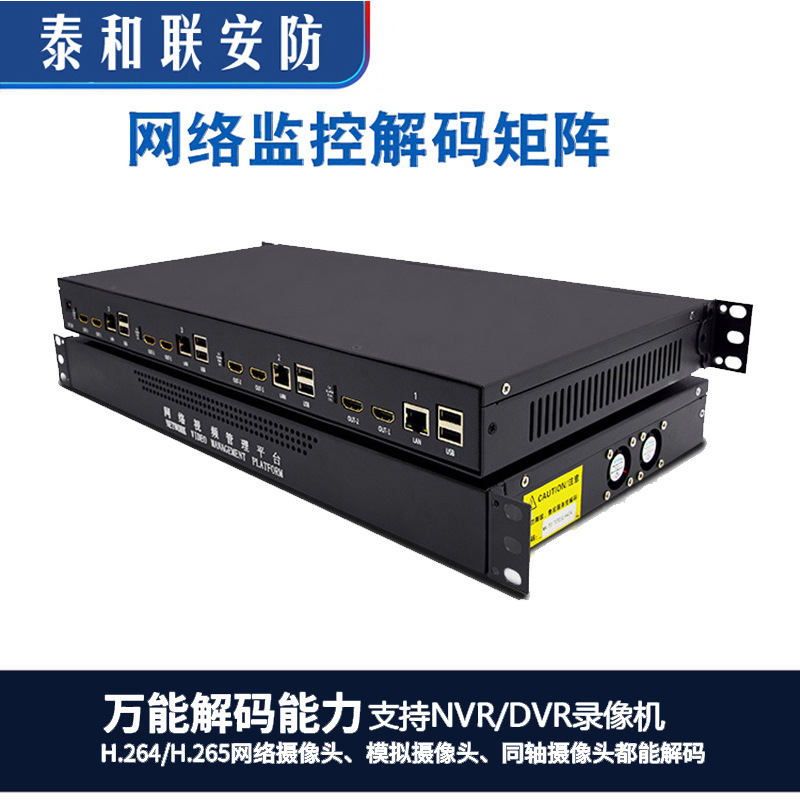
What Is a Video Surveillance Decoder Matrix?
A decoder matrix takes compressed network video streams from IP cameras, NVRs, or encoding platforms and converts them into uncompressed HDMI, VGA, or BNC signals for direct display on monitors and video walls. Unlike a simple decoder box, a matrix system can route many inputs to many outputs, letting an operator push any camera feed to any screen at any time. The DS-6A01UD/6A04UD/6A08UD family is built around this matrix concept, offering a 2-screen HD decoding matrix specification with integrated splicing and control logic — meaning video wall layout, window splitting, and screen stitching can all be managed from the decoder itself rather than requiring a separate controller.
Key Specifications at a Glance
The hardware is designed for continuous 24/7 operation in monitoring centers, transportation hubs, industrial campuses, and retail chains. Below is a summary of the core parameters shared across the series.
| Parameter | Specification |
|---|---|
| Model Numbers | DS-6A01UD / DS-6A04UD / DS-6A06UD / DS-6A08UD |
| Product Type | Multi-channel HDMI HD video surveillance decoder matrix |
| Configuration | 2-screen HD decoder matrix with built-in splicing control |
| HDMI Outputs | 16 |
| VGA Outputs | 48 |
| BNC Outputs | 8 |
| Input Interfaces | 8 |
| Audio Outputs | 16 |
| Alarm Inputs / Outputs | 8 / 8 |
| Network Interface | 1 |
| Power Supply | External, 220V |
| Power Consumption | 45W |
| Working Temperature | -20°C to 75°C |
| Working Humidity | 35 |
| Dimensions | 450 |
| Weight | 22.3 |
| Wi-Fi | Not supported |
| Composite Merging (Multi-Stream Combining) | Not supported |
| Place of Origin | China |
Why the Output Density Matters
The most striking feature of this decoder matrix is its output capacity. With 16 HDMI outputs, 48 VGA outputs, and 8 BNC outputs available on the platform, integrators can drive a genuinely large display estate from a single unit. In practice this means:
- HDMI for modern displays — full high-definition digital video to LED monitors, LCD video walls, and large-format panels.
- VGA for legacy and secondary screens — an economical path to feed analogue or hybrid monitoring desks without adding converters.
- BNC for CCTV-style monitors — ideal for retaining existing analogue monitor walls in retrofit projects.
- 16 audio outputs — synchronized audio distribution for zones where sound monitoring is required.
Because HDMI, VGA, and BNC outputs coexist on the same chassis, the decoder matrix bridges the gap between older analogue infrastructure and new digital control rooms. That flexibility is often the deciding factor in upgrade projects where replacing every monitor is simply not in the budget.
Built-In Splicing Control for Video Walls
Traditional video wall projects require a separate splicing controller, additional cabling, and extra rack space. This series integrates splicing and control functions directly into the decoder matrix, which delivers several practical benefits:
- Fewer devices in the rack, reducing points of failure and installation time.
- Simplified cabling between the decoder and the display wall.
- Faster commissioning, because screen layout and window arrangement are configured in one place.
- Lower total project cost compared with a decoder-plus-controller architecture.
The 2-screen HD decoding matrix configuration is particularly well suited to command centers that use paired display walls — for example, a live-view wall plus an analytics or playback wall — where operators need to move windows between screens without switching hardware profiles.
Input, Alarm, and Network Capabilities
Eight input interfaces give the unit headroom to accept multiple sources, while the single network interface keeps deployment straightforward: one uplink to the surveillance network is enough to pull streams from cameras and NVRs. The 8 alarm inputs and 8 alarm outputs make the decoder a useful node in a broader security ecosystem — door contacts, motion detectors, or perimeter sensors can trigger display changes or alert indicators, and alarm events can be pushed out to external devices. This tight coupling between video and alarm signaling is what turns a decoder from a passive display device into an active part of the incident response workflow.
Engineered for Harsh and Demanding Environments
Control rooms are not the only deployment target. With an operating temperature range of -20°C to 75°C, the decoder matrix is comfortable in environments that would challenge consumer-grade electronics — from unheated warehouses and outdoor equipment cabinets to hot plant rooms and traffic management shelters. A 45W power consumption figure keeps heat generation and energy costs low, which matters when multiple units are stacked in a single rack. The external 220V power supply simplifies replacement and maintenance, and the 22.3 weight with a 450 dimension profile reflects a solid, rack-friendly chassis built for permanent installation.
Deployment Scenarios
Where does this decoder matrix deliver the most value?
- City and traffic surveillance centers — aggregating hundreds of camera streams onto large video walls with fast window switching.
- Industrial and campus security rooms — mixing HDMI, VGA, and BNC monitors in a single operational view.
- Retail chains and logistics hubs — cost-sensitive projects that need high output counts without a separate controller.
- Retrofit and expansion projects — reusing existing analogue monitors while adding new HD displays.
- Building management and command rooms — combining video monitoring with alarm event visualization.
Selection Tips Before You Buy
When choosing among the DS-6A01UD, DS-6A04UD, DS-6A06UD, and DS-6A08UD variants, start by mapping your display inventory. Count how many HDMI, VGA, and BNC screens you need to drive, then confirm the decoder's output allocation matches that mix. Next, verify your video management software can output standard network streams to the decoder, since the unit does not support composite stream merging — each stream is decoded individually. Finally, plan the alarm wiring in advance if you intend to use the 8 alarm inputs and 8 alarm outputs for sensor-triggered display switching. Because Wi-Fi is not supported, a stable wired network connection is essential for reliable operation.
Final Thoughts
The multi-channel HDMI HD video surveillance decoder matrix series DS-6A01UD/6A04UD/6A08UD represents a sensible middle ground in the decoder market: high output density, integrated splicing control, wide environmental tolerance, and modest power draw, all in one chassis. For integrators who need to build or upgrade a video wall without the cost and complexity of a separate controller, this platform deserves a place on the shortlist. With its combination of 16 HDMI, 48 VGA, and 8 BNC outputs and built-in splicing logic, it is a practical, future-ready foundation for modern surveillance display infrastructure.