

 CN

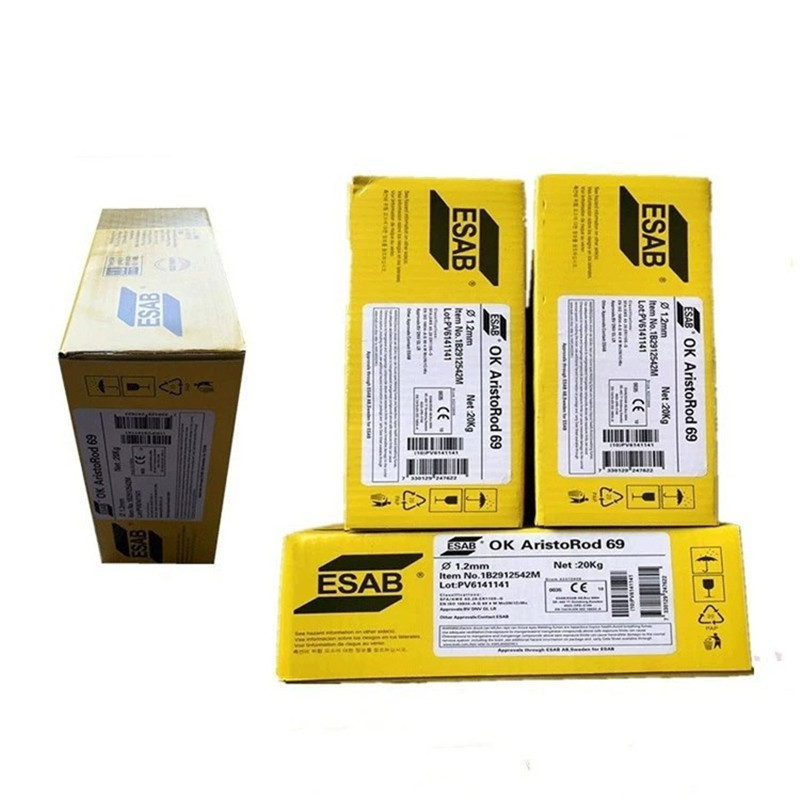
ESAB A5.10 Swedish Isa OK Autrod 5183 aluminum alloy welding wire ER5183 aluminum-magnesium alloy welding wire
ESAB OK Autrod 5183 (ER5183) Aluminum Magnesium Welding Wire: The Professional Choice for Marine and Structural Welding
When welding high-strength aluminum alloys for marine, offshore, transportation, and structural applications, filler metal selection is not a detail — it is the foundation of joint integrity. ESAB OK Autrod 5183 (ER5183) is a Swedish-made, solid aluminum-magnesium welding wire engineered to deliver high tensile strength, excellent fracture toughness, superior impact resistance, and reliable performance in corrosive environments. This guide explains what makes ER5183 different, where it should be used, and how to choose the right diameter for your project.
What Is ESAB OK Autrod 5183?
ESAB OK Autrod 5183 is a solid aluminum-magnesium (AlMg4.5Mn) filler wire containing approximately 4.3–5.2% magnesium, with manganese additions that refine the microstructure and improve strength. It is classified as ER5183 under the AWS A5.10 standard and is the go-to filler for welding the 5083 and 5086 base alloys — two of the most widely used high-strength aluminum alloys in shipbuilding and heavy structures.
The wire is manufactured by ESAB in Sweden (Item No. 075218) and carries both AWS A5.10 industry certification and RoHS environmental compliance, making it suitable for projects where documentation, traceability, and environmental standards matter.
Why Choose ER5183 Instead of ER5356?
ER5356 is the most common aluminum filler metal, but ER5183 offers measurable advantages in demanding applications:
- Higher as-welded strength — ER5183 typically produces weld deposits with tensile strengths around 290–310 MPa, noticeably above standard ER5356 deposits.
- Better fracture toughness — manganese additions improve resistance to crack propagation in thick-section and restrained joints.
- Excellent corrosion resistance — particularly in seawater and salt-spray exposure, ideal for marine fabrication.
- Strong impact performance — critical for structures subject to dynamic loading, vibration, or low-temperature service.
- Good color match after anodizing — an important detail for architectural and visible welded assemblies.
In short: when a weld must hold under load, in salt water, or under cyclic stress, ER5183 provides a safety margin that general-purpose fillers cannot match.
Technical Specifications
| Parameter | Specification |
|---|---|
| Brand | ESAB |
| Model | OK Autrod 5183 |
| Classification | ER5183 (AWS A5.10) |
| Item Number | 075218 |
| Alloy Type | Aluminum-magnesium solid wire (AlMg4.5Mn) |
| Approximate Composition | Mg 4.3–5.2%, Mn 0.50–1.0%, Cr 0.05–0.25%, balance Al |
| Available Diameters | 0.8 mm / 1.0 mm / 1.2 mm / 1.6 mm / 2.4 mm |
| Country of Origin | Sweden (imported) |
| Certifications | AWS A5.10, RoHS environmental compliance |
| Primary Applications | Marine, structural, transportation, pressure vessels, offshore |
Typical Applications
ER5183 is specified wherever high strength and corrosion resistance must coexist:
Marine and Shipbuilding
Hulls, decks, superstructures, masts, and aluminum boat components welded from 5083 and 5086 plate and extrusions. The filler's seawater corrosion resistance and impact toughness are essential for vessels exposed to constant salt-water contact and wave loading.
Structural Fabrication
Bridges, pedestrian walkways, crane components, railings, and load-bearing frames where aluminum's strength-to-weight ratio is combined with welded joint reliability.
Transportation
Aluminum truck bodies, tanker trailers, railcar panels, and chassis assemblies that require fatigue resistance under repeated loading.
Chemical and Cryogenic Equipment
Tanks, pressure vessels, and piping that handle corrosive media or operate at low temperatures, where toughness at sub-zero conditions is a design requirement.
Offshore and Energy
Platform structures, walkways, cable trays, and support systems in harsh coastal and offshore environments.
How to Select the Right Diameter
Choosing the correct wire diameter directly affects arc stability, deposition rate, and weld quality:
- 0.8 mm — thin gauge sheet, low-current welding, precision work with minimal distortion.
- 1.0 mm — general-purpose sheet and light structural work; the most popular choice for MIG welding of thin-to-medium sections.
- 1.2 mm — the workhorse diameter for production MIG welding on medium-thickness aluminum plate.
- 1.6 mm — heavy plate, high-deposition-rate welding, and thicker structural joints.
- 2.4 mm — thick-section work, high-current applications, and automated or semi-automated systems requiring high deposition.
Welding Tips for Best Results with ER5183
Aluminum welding demands attention to detail. Follow these practical guidelines to get the most out of ESAB OK Autrod 5183:
- Use the right shielding gas. Pure argon (99.99%) is standard. For thicker sections, adding 30–50% helium improves penetration and heat input.
- Switch to push-pull or spool-gun feeding. Aluminum wire is soft; a push-pull torch system or spool gun prevents bird-nesting and feed inconsistency.
- Clean the surface thoroughly. Remove oxides, oil, and moisture before welding. Use a dedicated stainless steel brush to avoid cross-contamination with steel.
- Keep heat input controlled. Aluminum conducts heat rapidly; use higher travel speeds and avoid excessive current to prevent hot cracking and distortion.
- Store the wire properly. Keep spools sealed until use and store in a dry environment to avoid surface oxidation and moisture pickup.
- Preheat thick sections if needed. For plates above 10 mm, preheating to 80–120°C can help fusion and reduce porosity risk.
Why Swedish-Made ESAB Wire Matters
ESAB is a global leader in welding technology, and its Swedish production lines apply strict dimensional tolerance control, surface cleanliness standards, and consistent alloy chemistry. For buyers, that translates into:
- Consistent wire diameter and smooth spooling for stable arc and reliable wire feeding
- Low surface oxide and minimal hydrogen content, reducing porosity
- Full traceability and documentation for certified fabrication work
- Compliance with AWS A5.10 and RoHS requirements for international projects
For fabricators working to specification, using a certified ER5183 wire from an established brand simplifies inspection, welding procedure qualification, and client acceptance.
Supply, Export, and Bulk Purchasing
This product is available as an exported supply item, suitable for distributors, fabricators, and trading companies sourcing welding consumables for international markets. It is particularly popular with buyers across Africa, where marine, construction, and transport fabrication is expanding rapidly. Orders can be placed through major B2B and B2C platforms including Baidu, Taobao, Pinduoduo, Alibaba (Aicaigou), Kuaishou, Douyin, Amazon, independent websites, AliExpress, Wish, and Lazada.
Value-added services include assistance with welding consumables import and export documentation, helping buyers manage customs clearance, certification requirements, and logistics for cross-border shipments.
Frequently Asked Questions
Is ER5183 better than ER5356?
For higher strength, better fracture toughness, and marine corrosion resistance, ER5183 is generally superior. ER5356 remains a good general-purpose filler where lower strength is acceptable and cost matters more.
Can ER5183 be used on 6061 aluminum?
Yes. ER5183 is a suitable filler for 6061 and other 6xxx alloys, providing good strength and crack resistance, though ER4043 or ER5356 are also commonly used depending on the application.
What base metals are best matched to ER5183?
It is primarily designed for welding 5083, 5086, and other 5xxx series alloys, and is also suitable for many 6xxx series alloys and dissimilar aluminum joints.
Does the wire come with certification?
Yes. ESAB OK Autrod 5183 conforms to AWS A5.10 and meets RoHS environmental requirements. Certificates and product documentation can be requested with your order.
Which diameter should I order first?
If you are unsure, start with 1.2 mm for general MIG fabrication. It offers the best balance of feedability, deposition rate, and performance across most medium-thickness aluminum applications.
Final Thoughts
In aluminum welding, the filler metal determines whether a joint will withstand years of salt water, vibration, and structural load — or fail early. ESAB OK Autrod 5183 (ER5183) delivers the combination of high strength, excellent fracture toughness, impact resistance, and corrosion protection that marine and structural work demands, backed by Swedish manufacturing quality, AWS A5.10 certification, and RoHS compliance.
With diameters from 0.8 mm to 2.4 mm and full export support for international buyers, it is a practical, specification-ready choice for professional fabricators and welding consumable distributors alike.